Video credit: Ultimate Reviewer / YouTube — “Top 5: Best Welding Work Boots.”
Welding is one of those jobs where your footwear is definitely not the place to get creative.
That stylish sneaker you wear on Saturday? Keep it for Saturday.
On the job, welders need boots that can deal with sparks, hot metal, heavy objects, slippery floors and hours of standing. A good pair of welding work boots should protect your feet without making every step feel like you’re carrying two bricks around.

And there is another detail that often gets overlooked: a normal safety-toe boot isn’t automatically a welding boot.
Welding creates a combination of hazards that can require additional protection over the top of the foot, along with materials and construction suited to heat and sparks.
That’s why we’ve revisited the classic welding-boot recommendations and created this updated guide for 2026.
Best Welding Work Boots: Quick Comparison
| Boot | Best For | Key Advantage |
|---|---|---|
| Timberland PRO 53530 Met Guard | Best overall | External metatarsal protection and heat-focused construction |
| KEEN Utility Louisville | All-day comfort | Internal met guard and supportive footbed |
| Timberland PRO Internal Met Guard | Mobility | Internal protection with less external bulk |
| CAT Revolver Steel Toe Pull-On | Lace-free convenience | Pull-on design and steel-toe protection |
| SAFETOE H-9552 | Heat and metatarsal protection | Metatarsal cover and welding-focused construction |
| Rock Fall Spark | Lightweight welding footwear | Flame-retardant materials and non-metallic construction |
| Dr. Martens Ironbridge MG ST | Classic heavy-duty style | Met guard, steel toe and rugged construction |
| Carolina INT HI Met Guard | Outdoor welding | High-cut protection and rugged traction |
If you’re also working around oil or greasy floors, compare these choices with our guide to the best oil- and slip-resistant work boots.
Why Welding Boots Are Different From Ordinary Work Boots
At first glance, a welding boot can look like any other rugged safety boot.
Look closer, though, and the differences start to make sense.
Welding can expose your feet to:
- Hot sparks and spatter
- Hot metal fragments
- Heavy tools and materials
- Sharp metal pieces
- Oil and other slippery substances
- Electrical hazards depending on the work environment
- Long periods of standing
A regular safety boot may deal with some of these hazards, but welding-specific footwear can add protection where a conventional boot stops.
Think of a standard safety toe as an umbrella.
Useful? Absolutely.
But if the rain is coming sideways, you may want a little more coverage.
What Should You Look for in Welding Work Boots?
1. Full-Grain Leather or Appropriate Heat-Resistant Material
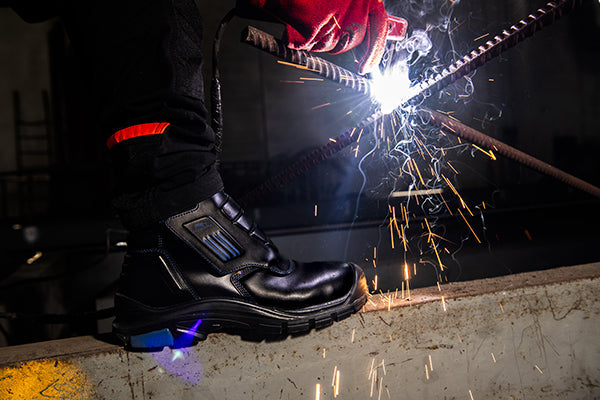
Welding footwear should be made from materials suited to the heat and sparks involved in your work.
Leather remains a popular choice because it is durable and can provide good coverage against sparks and abrasion.
For specialist foundry or molten-metal applications, look for footwear specifically tested for that environment rather than assuming an ordinary leather boot is sufficient.
2. Metatarsal Protection
This is one of the biggest differences between a general work boot and a serious welding boot.
The safety toe protects the front of your foot.
A metatarsal guard protects the bones across the top of your foot.
That area can be exposed to falling tools, metal pieces and other impact hazards.
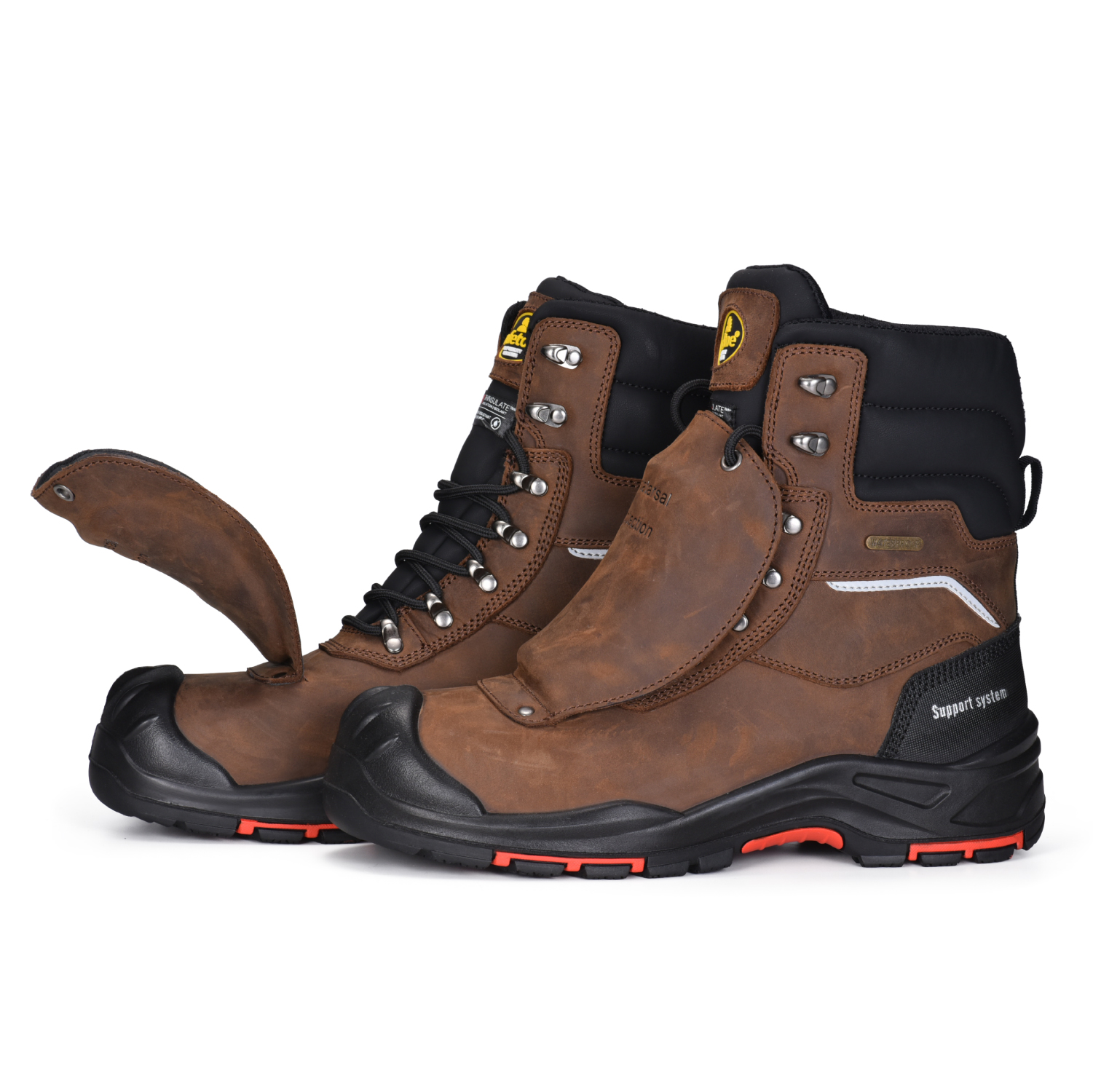
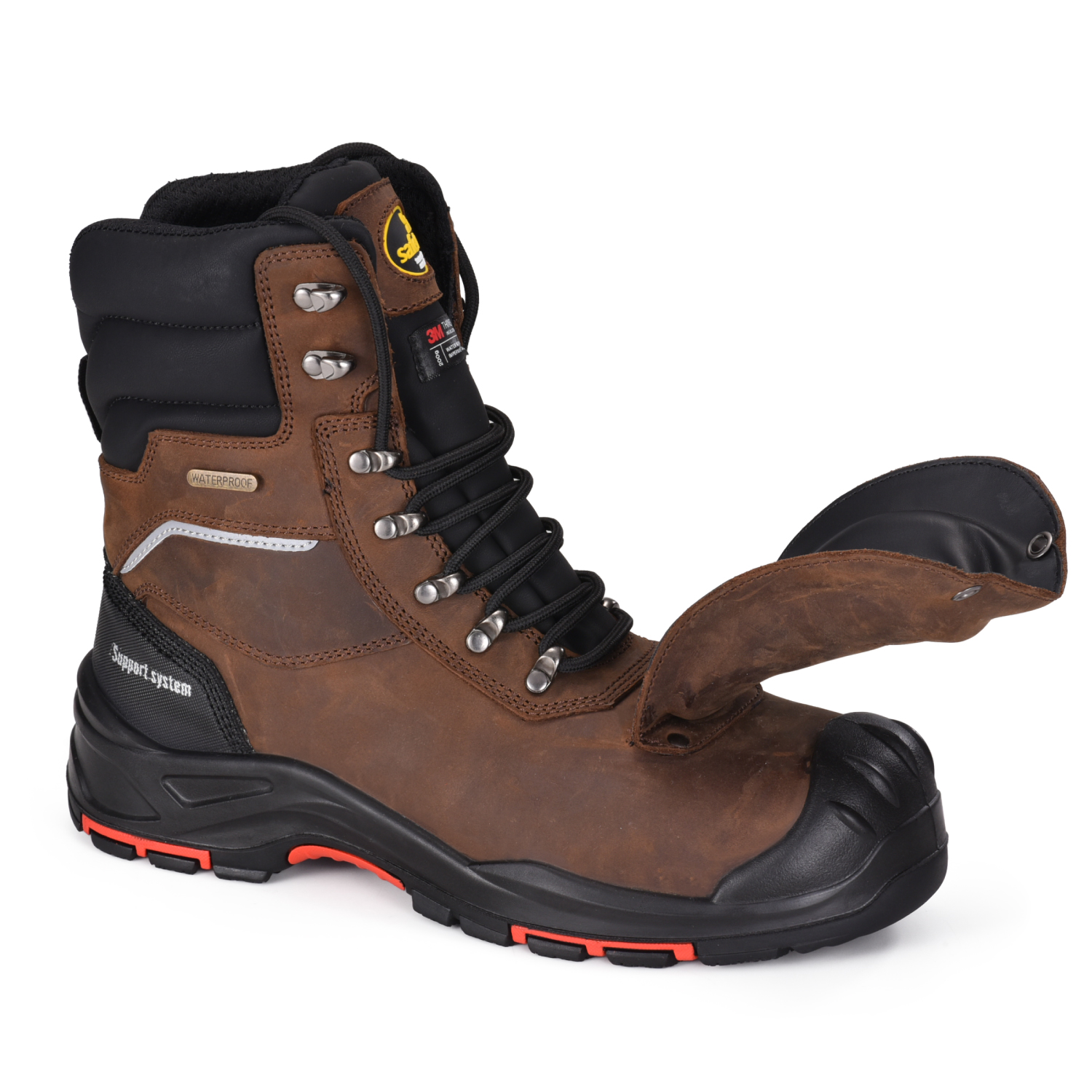
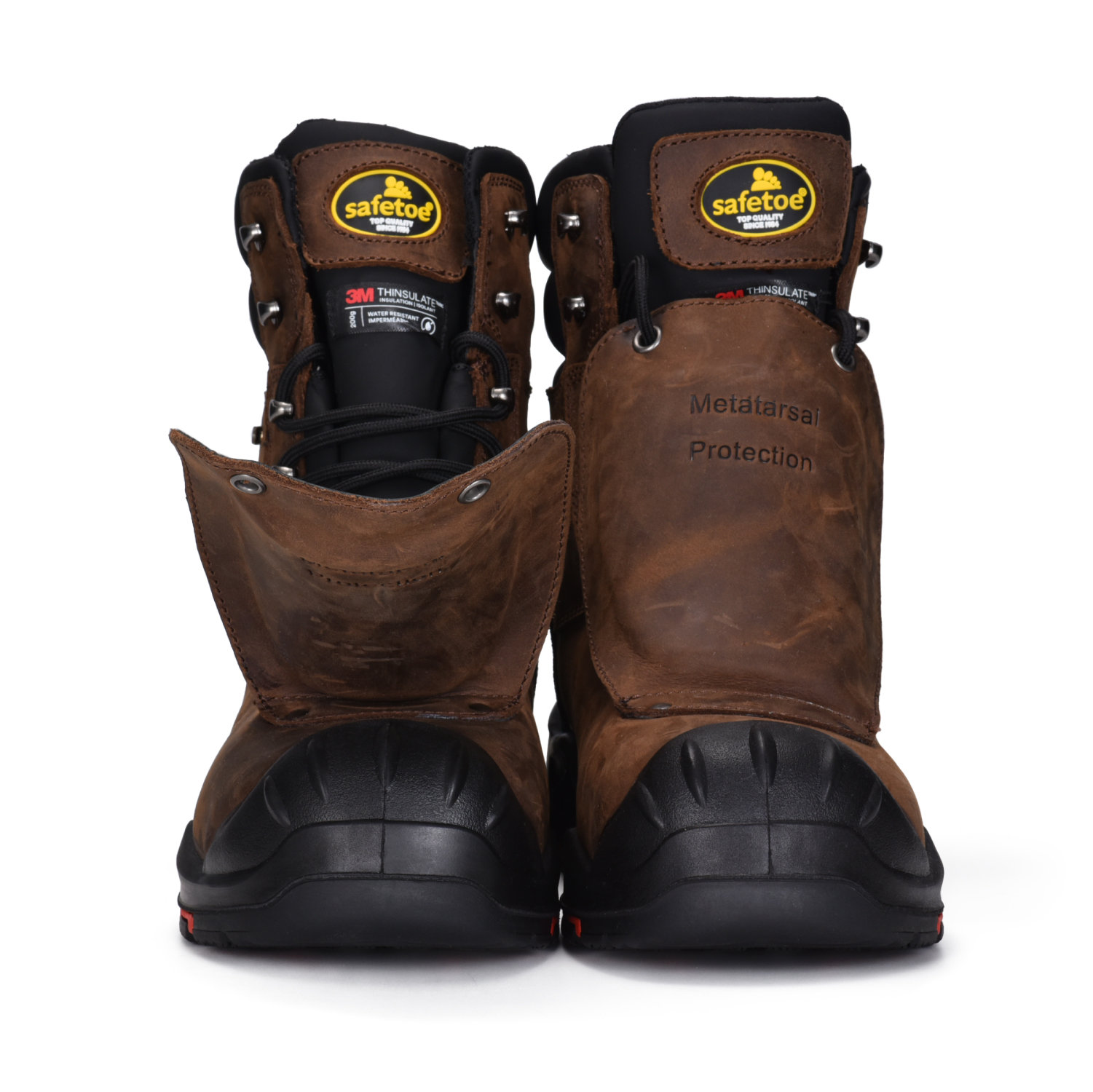
Met guards can be internal or external. Internal guards are tucked inside the boot’s structure, while external guards are visible over the upper.
Neither design is automatically perfect for everyone.
External guards can provide a very obvious layer of protection but may feel bulkier. Internal designs can offer a cleaner profile and easier movement.
3. A High Enough Shaft
Welding boots shouldn’t leave a giant open invitation around your ankle.
A taller boot can help reduce the chance of sparks and hot debris entering from the top.
This is especially important when you’re working in positions where sparks are falling downward.
4. Protected Laces or a Pull-On Design
Here’s something welders learn quickly: sparks and shoelaces are not best friends.
Hot material can land on exposed laces, which is one reason some welding boots use protective flaps or pull-on designs.
A pull-on boot eliminates the lace problem altogether.
5. Heat-Resistant Outsole
The sole needs to cope with the surfaces you actually work on.
Some welding and foundry footwear uses specialized heat-resistant rubber compounds designed for demanding industrial conditions.
However, don’t confuse an outsole’s heat rating with the ability of the entire boot to withstand every heat source imaginable.
The complete boot and the specific hazard need to be considered.
6. Slip Resistance
Metal shops can contain oil, water, dust, grinding debris and other substances that make floors unpredictable.
A slip-resistant outsole can help, but no boot can eliminate every slip hazard.
Good housekeeping and proper workplace procedures still matter.
7. Comfortable Footbeds
Welders can spend most of their day standing in one place.
That means cushioning matters.
A boot can be incredibly protective and still be a terrible boot if your feet start screaming at 11:30 a.m.
If foot comfort is a major concern, our guide to the best work boots for plantar fasciitis covers several useful support features.
1. Timberland PRO 53530 Met Guard — Best Overall Welding Boot
The Timberland PRO 53530 Met Guard remains one of the most recognizable heavy-duty welding-style boots.
Its biggest attraction is right there in the name: metatarsal protection.
The 8-inch configuration combines a steel safety toe with an external hinged metatarsal guard. The guard is designed to move with the foot when you squat, which is useful because welders rarely spend an entire shift standing perfectly upright.
The boot also uses Ever-Guard leather, a waterproof membrane, heat-resistant thread and a heat-, oil- and slip-resistant rubber outsole.
Why It Stands Out
- 8-inch height
- Steel safety toe
- External hinged metatarsal guard
- Waterproof leather configuration
- Electrical-hazard protection
- Heat-resistant thread
- Heat-, oil- and slip-resistant outsole
- Goodyear welt construction
The biggest downside is weight.
This is not the boot you buy because you want to feel like you’re wearing slippers.
You buy it because your work environment demands serious protection.
For welders handling heavy plate, structural steel or working around significant impact hazards, that trade-off can make sense.
Check Timberland PRO’s current Met Guard specifications
2. KEEN Utility Louisville — Best for All-Day Comfort
The KEEN Utility Louisville takes a slightly different approach.
Instead of putting a large external shell over the top of the boot, the Louisville uses an internal metatarsal guard.
That can be attractive if you want protection without quite as much external bulk.
The Louisville range has been designed for demanding industrial work and includes versions with waterproof construction, steel safety toes and electrical-hazard protection.
Why Consider It?
- Internal metatarsal protection
- Steel safety toe
- Waterproof construction on applicable versions
- Oil- and slip-resistant outsole
- Removable cushioned footbed
- Comfort-focused fit
- Good choice for long shifts
This is the type of boot I’d look at when your work requires protection but you also spend hours walking, climbing and moving around.
If your feet are wider than average, KEEN’s fit philosophy can also be worth exploring.
For another comfort-oriented comparison, see our guide to the best work boots for flat feet.
3. Timberland PRO Internal Met Guard — Best for Mobility
If you like the Timberland PRO approach but don’t want a large external guard, an internal metatarsal guard Timberland PRO model is worth considering.
Current Timberland PRO internal-met models combine steel safety toes with internal anatomical metatarsal protection, electrical-hazard protection, structural support and heat-, oil- and slip-resistant outsoles.
The internal guard is made from materials designed to provide impact resistance while remaining integrated into the boot.
That makes this style particularly interesting for workers who squat, climb or move around frequently.
Best For
- Fabrication shops
- General welding
- Workers who move frequently
- People who dislike bulky external guards
- Long industrial shifts
One important point: always verify the exact model number. Timberland PRO sells several met-guard configurations, and the safety features can vary between models.
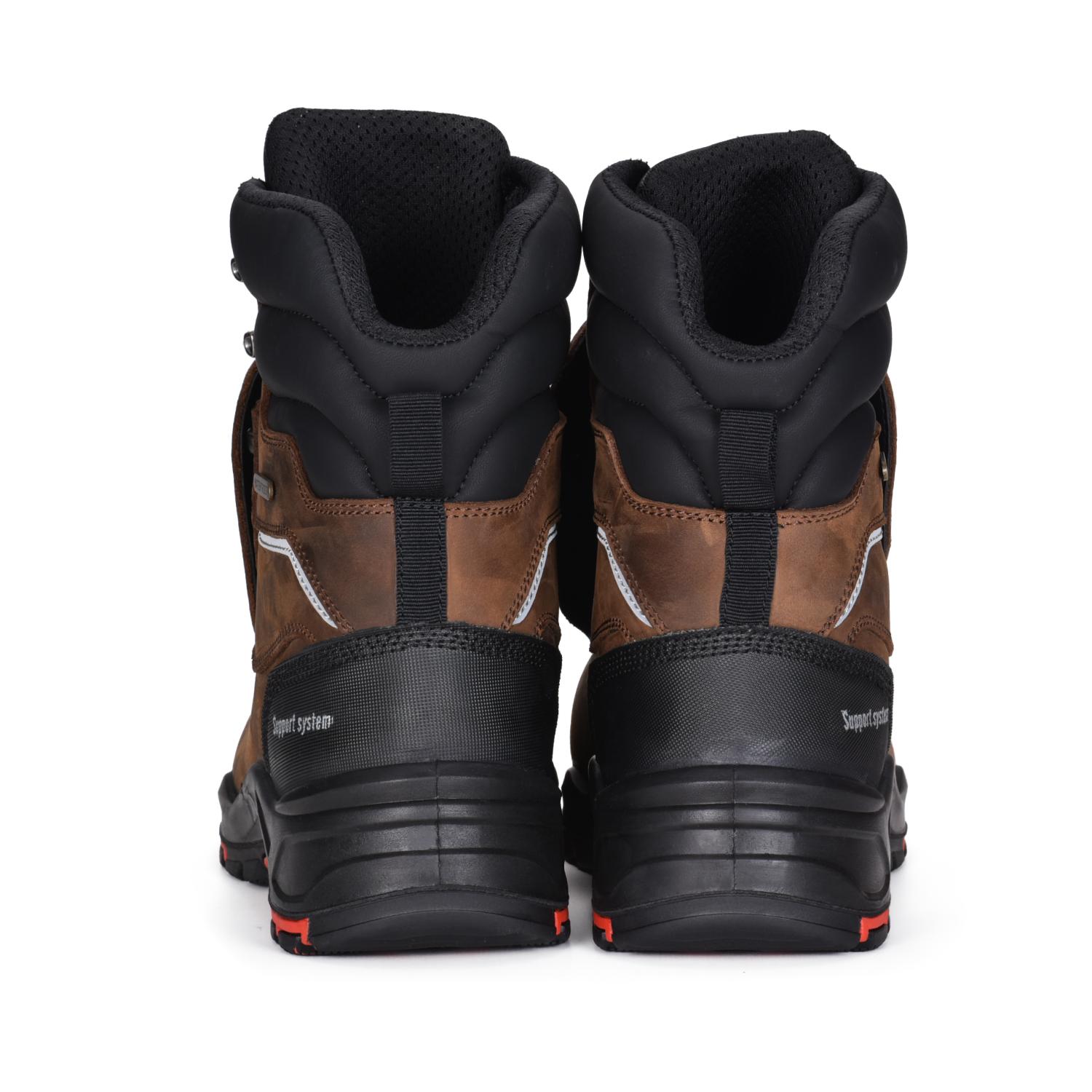
4. CAT Revolver Steel Toe Pull-On — Best Lace-Free Welding Work Boot
Some workers simply don’t want laces.
Fair enough.
After spending a day around welding equipment, hot metal and grinding dust, the last thing you may want to do is sit down and untie a knot that appears to have been tied by an angry sailor.
The CAT Revolver Steel Toe Pull-On solves that problem with a classic Wellington-style design.
The current P89516 configuration uses a full-grain leather upper, steel safety toe, electrical-hazard protection, slip-resistant rubber outsole and Goodyear welt construction.
Why Welders May Like It
- Pull-on design
- No exposed laces
- Full-grain leather
- Steel safety toe
- Electrical-hazard protection
- Slip-resistant outsole
- Goodyear welt construction
It is particularly appealing for workers who want a traditional leather work boot that can be put on quickly.
However, if your welding environment specifically requires metatarsal protection, make sure the exact boot you choose provides it. A steel toe by itself does not protect the entire top of your foot.
For more pull-on options, check our best Wellington work boots guide.
5. SAFETOE H-9552 Metatarsal — Best Welding-Focused Protection
The SAFETOE H-9552 is designed specifically around the sort of protection welders and industrial workers look for.
The boot combines a protective metatarsal cover with a composite safety toe and a puncture-resistant non-metallic plate. The manufacturer also lists heat-resistant outsole performance, slip resistance and ASTM F2413-24 testing information for the model.
That is a substantial collection of safety features.
Key Features
- Metatarsal protection
- Composite safety toe
- Full-grain leather upper
- Non-metallic puncture-resistant plate
- Anti-fatigue memory-foam insole
- Slip-resistant outsole
- Oil-resistant outsole performance
- Welding and industrial applications
The composite-toe construction may also appeal to workers who prefer non-metallic footwear.
Just remember that the exact requirements of your workplace should always determine which safety classification you need.
6. Rock Fall Spark — Best Lightweight Welding Safety Boot
If you want welding-specific protection but don’t want to feel like you’re wearing medieval armor, the Rock Fall Spark is an interesting alternative.
The Spark is built around flame-retardant full-grain leather, flame-resistant stitching, a protective fibreglass toe cap and a composite anti-penetration midsole.
Its outsole is designed for heat, abrasion and cold performance, while the footbed is aimed at breathable comfort.
Why It Is Interesting
- Flame-retardant full-grain leather
- Flame-resistant stitching
- Non-metallic safety construction
- Composite anti-penetration midsole
- Breathable footbed
- Heat-resistant outsole
- Designed specifically for welding environments
This makes it particularly appealing for workers who want a more streamlined welding boot.
It also shows why simply searching for “steel toe work boots” isn’t enough. Welding footwear is a much more specific category.
7. Dr. Martens Ironbridge MG ST — Best Heavy-Duty Classic
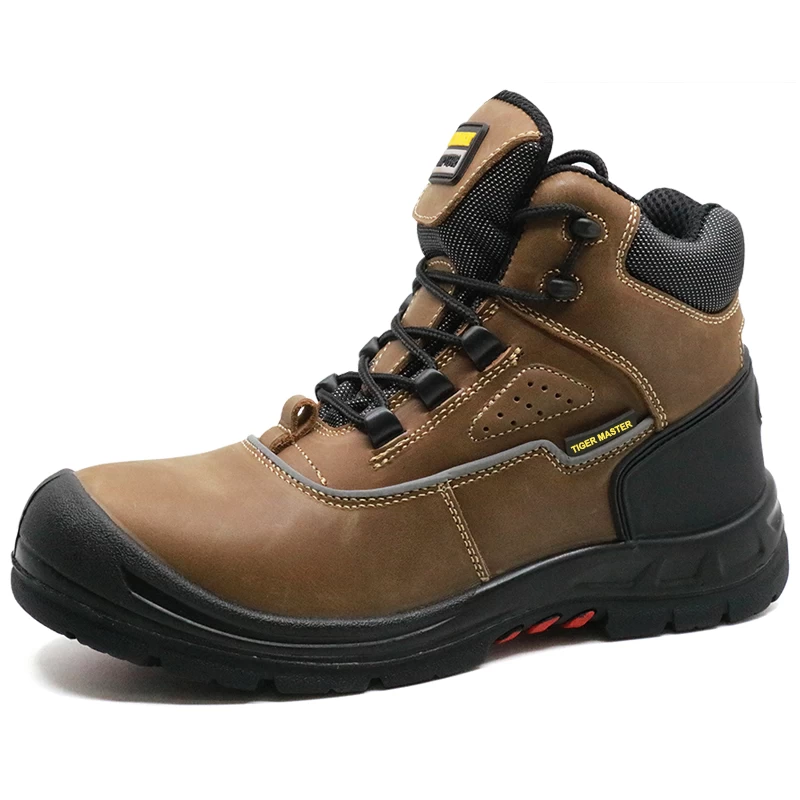
The Dr. Martens Ironbridge MG ST has a distinctive appearance, but its jobsite credentials are more important than its looks.
The Ironbridge MG ST was designed with a steel toe and metatarsal guard, along with a rugged outsole intended to provide traction in demanding working environments.
The leather upper gives it the traditional heavy-duty look many workers prefer.
Best For
- Heavy-duty fabrication
- Industrial workshops
- Workers who prefer traditional leather boots
- Jobs requiring metatarsal protection
- People who want a distinctive work-boot design
It is worth remembering that a rugged-looking outsole doesn’t automatically make a boot perfect for every floor. If you regularly work around oil, compare the outsole specification with your workplace requirements.
8. Carolina INT HI Met Guard — Best for Outdoor Welding
Field welding is different from standing inside a controlled fabrication shop.
Outdoors, you may have uneven ground, mud, gravel, rain and debris joining the party.
That’s where a taller, rugged work boot such as the Carolina INT HI Met Guard becomes interesting.
The design combines a high-cut profile with metatarsal protection and a rugged outsole, making this style particularly suitable for outdoor welding and mixed construction work.
Why Field Welders May Prefer It
- Taller shaft
- Metatarsal protection
- Steel safety toe on applicable versions
- Electrical-hazard protection on applicable models
- Rugged outdoor outsole
- Good ankle coverage
If you spend more time outside than inside, don’t automatically choose the lightest welding boot. Terrain changes the equation.
For rugged outdoor work, you may also want to compare our best farm and ranch work boots.
Internal vs. External Metatarsal Guards
This is one of the most common questions when shopping for welding boots.
| Feature | Internal Guard | External Guard |
|---|---|---|
| Appearance | Cleaner profile | More visible |
| Bulk | Usually lower | Usually higher |
| Mobility | Often easier | Can feel more substantial |
| Heavy-duty protection | Excellent when properly rated | Excellent when properly rated |
| Best fit | Mobile welding and mixed trades | Heavy fabrication and high-impact environments |
The key word is rated.
Don’t assume a large-looking piece of material on top of a boot automatically qualifies as certified metatarsal protection. Check the manufacturer’s certification for the exact model.
Steel Toe vs. Composite Toe for Welding
Both steel and composite safety toes can be legitimate choices when they meet the required safety standard.
Steel Toe
Steel remains popular because it is durable, widely available and proven in industrial footwear.
The downside is that steel can add weight.
Composite Toe
Composite toes are non-metallic and can offer a lighter alternative depending on the boot design.
They’re attractive to workers who want less weight or have workplace requirements that make non-metallic footwear useful.
But don’t assume composite means weaker or steel means automatically safer. What matters is whether the exact boot has been properly tested and certified for the protection you need.
OSHA requires protective footwear in workplaces where hazards such as falling or rolling objects, objects piercing the sole or certain electrical hazards are present, and its standard references recognized protective-footwear consensus standards.
Read OSHA’s official foot-protection requirements
Why High-Cut Welding Boots Matter
Imagine a tiny piece of hot metal landing on your ankle.
Now imagine it immediately finding the one gap in your boot.
Not fun.
A higher boot can provide more coverage around the ankle and lower leg. It can also reduce the number of easy entry points for sparks and debris.
That doesn’t mean every welder needs an enormous 12-inch boot. The right height depends on your work position, welding process, PPE requirements and the hazards identified at your workplace.
Why Covered Laces Can Be a Big Deal
Traditional laces are convenient, but they’re also exposed.
Some welding boots use leather flaps or guards over the laces. Others use pull-on designs.
That’s not merely a fashion choice.
It is about reducing exposed areas where hot particles can land or become trapped.
If you routinely weld overhead or work with large amounts of spatter, think carefully about the boot’s entire upper rather than just the toe cap.
What About Waterproof Welding Boots?
Waterproofing can be useful for outdoor welding, construction and jobs where rain is part of the working day.
But there is a trade-off.
A completely sealed boot can become warm inside, especially during a long shift in a hot fabrication shop.
That’s why workers in hot environments should pay attention to lining, moisture management and breathability in addition to waterproofing.
If heat and sweaty feet are your biggest problem, our guide to the best breathable work boots may help.
How Comfortable Should Welding Boots Be?
Very.
Seriously.
Safety does not mean you need to spend eight hours walking around in footwear that feels like punishment.
Look for:
- Secure heel fit
- Enough toe room
- Good arch support
- Cushioned footbed
- Stable midsole
- Reasonable boot weight
- Comfortable collar
- Breathable lining when appropriate
Try the boots with your normal welding socks.
And don’t make the classic mistake of trying them on for two minutes and declaring them perfect.
Two minutes isn’t a work shift.
Walk around. Squat. Bend. Climb a step. Move as you would at work.
Your feet will give you much better feedback.
Welding Boots for Standing on Concrete
Many welders spend most of their day on concrete.
Concrete is unforgiving.
After several hours, a mediocre footbed can make your feet feel like you’ve been standing on a parking lot since the invention of electricity.
If your work surface is mostly flat concrete, look for:
- Cushioned footbeds
- Stable midsoles
- Moderate outsole flexibility
- Good heel support
- Comfortable weight
- A fit that doesn’t squeeze your toes
Our guide to the best work boots for plantar fasciitis also covers footwear considerations for long periods of standing.
How to Keep Welding Boots in Good Shape
Remove Metal Debris
Brush away grinding dust, slag fragments and other debris regularly.
Inspect the Outsole
Look for excessive wear, cracking or separation.
Check the Met Guard
If your boot has an external guard, inspect it for damage after heavy impacts.
Clean Leather Properly
Use cleaning and conditioning products suitable for the specific leather.
Don’t Blast Wet Boots With Extreme Heat
High heat can damage leather, adhesives and other boot components.
Let them dry naturally in a ventilated area whenever possible.
Replace Damaged Safety Footwear
If the safety toe, metatarsal guard or outsole has suffered serious damage, don’t gamble on the boot continuing to provide the protection it was designed to provide.
Common Welding Boot Buying Mistakes
1. Buying a Normal Work Boot
A steel toe doesn’t automatically make a boot suitable for welding.
2. Ignoring the Metatarsals
If your work involves falling objects or heavy metal, protection over the top of the foot can be just as important as toe protection.
3. Choosing Fashion Over Function
A gorgeous boot isn’t much use if sparks can enter through the top.
4. Buying the Wrong Size
A loose heel can cause instability. A cramped toe box can turn a long shift into misery.
5. Ignoring Your Workplace Requirements
Always check what your employer requires before purchasing. Different workplaces and countries can use different standards.
6. Assuming “Heat Resistant” Means “Molten Metal Proof”
It doesn’t.
Heat ratings are specific to particular components and tests. If you work in a foundry or around molten metal, look for footwear specifically designed and certified for those hazards.
Do Welders Need Metatarsal Guards?
Not every welding job automatically requires the same level of footwear protection.
The answer depends on the hazards present.
If you’re welding small parts on a controlled bench, your risks may be different from someone welding structural steel while handling heavy plates and working underneath overhead equipment.
Perform a proper workplace hazard assessment and follow your employer’s PPE requirements.
The goal isn’t to buy the most armored boot on Earth.
The goal is to buy the right protection for the hazards you actually face.
Welding Boots vs. Regular Steel-Toe Work Boots
| Feature | Regular Safety Boot | Welding-Focused Boot |
|---|---|---|
| Safety toe | Often | Usually |
| Met guard | Not always | Common on specialized models |
| Heat-focused construction | Varies | Major consideration |
| Protected laces | Less common | Common on some models |
| High shaft | Depends on model | Often desirable |
| Spark protection | Depends on materials | A central design consideration |
Best Welding Boots for Different Types of Welders
Best for Structural Steel Welding
Prioritize metatarsal protection, high coverage, durable leather, heat-resistant construction and strong traction.
The Timberland PRO 53530 is an especially interesting option.
Best for Shop Welding
If you’re primarily indoors and constantly moving around a fabrication shop, an internal met guard can offer a good balance between protection and mobility.
Best for Field Welding
Look for a taller boot with a rugged outsole, weather resistance and strong ankle coverage.
Best for Workers Who Hate Laces
A pull-on boot such as the CAT Revolver can make the start and end of the day much easier.
Best for Workers Wanting Non-Metallic Construction
Look at composite-toe and non-metallic safety footwear, but verify the certification and suitability for your specific workplace.
Frequently Asked Questions
What are the best work boots for welding?
The Timberland PRO 53530 Met Guard is our top overall pick because it combines a steel safety toe, metatarsal protection, high coverage and heat-focused construction. KEEN Utility, SAFETOE, CAT and other manufacturers also offer strong options depending on your work environment.
Do welding boots need steel toes?
Not necessarily. Composite and other non-metallic safety toes can also provide certified protection when the specific boot meets the required standard. Your workplace requirements should determine the choice.
What is the most important feature of a welding boot?
There isn’t one universal feature. For many welders, the combination of appropriate upper material, metatarsal protection, safety-toe protection, adequate shaft height, heat-resistant components, traction and comfort is more important than any single feature.
Are metatarsal guards worth it for welding?
If your work involves falling objects, heavy metal, tools or other hazards that could strike the top of your foot, metatarsal protection can be extremely valuable. Always base the decision on the hazards identified at your workplace.
Are pull-on boots good for welding?
They can be. Pull-on boots eliminate exposed laces and are quick to put on and remove. However, make sure the specific model provides the safety features required for your job.
Can I use normal steel-toe boots for welding?
Sometimes, but not automatically. A standard steel-toe boot may protect the toes but lack metatarsal protection, heat-focused materials or other features useful for welding. Check the hazards and the boot’s specifications before using it.
Are leather boots better for welding?
Leather is a popular material for welding footwear because it provides durable coverage and can handle sparks better than many lightweight synthetic materials. However, the exact leather treatment and boot construction matter.
Should welding boots be waterproof?
Waterproofing is useful for outdoor and wet environments, but it isn’t necessarily the top priority for every indoor welder. In hot shops, breathability and moisture management can become more important.
How high should welding boots be?
Many welders prefer boots with a taller shaft because it provides additional coverage around the ankle and lower leg. The ideal height depends on the welding position, PPE requirements and workplace hazards.
Final Ranking: Best Work Boots for Welding in 2026
- Timberland PRO 53530 Met Guard — Best overall for serious welding and heavy fabrication.
- KEEN Utility Louisville — Best balance of metatarsal protection and all-day comfort.
- Timberland PRO Internal Met Guard — Best for workers who want protection with less external bulk.
- CAT Revolver Steel Toe Pull-On — Best lace-free option for general industrial work.
- SAFETOE H-9552 — Best welding-focused combination of metatarsal and underfoot protection.
- Rock Fall Spark — Best streamlined welding-specific safety boot.
- Dr. Martens Ironbridge MG ST — Best classic heavy-duty option.
- Carolina INT HI Met Guard — Best for outdoor and field welding.
So, Which Welding Boot Should You Buy?
If you’re doing serious fabrication work and want maximum coverage, start with the Timberland PRO 53530 Met Guard.
If comfort and mobility are especially important, the KEEN Utility Louisville deserves a close look.
If you want metatarsal protection without a big external shell, consider an internal-met Timberland PRO model.
If you hate laces — and honestly, who hasn’t cursed at a boot lace at least once? — the CAT Revolver is an appealing pull-on alternative.
For a welding-specific design with composite safety components and metatarsal coverage, the SAFETOE H-9552 is another interesting option.
And if you’re working outdoors, don’t underestimate the value of a taller boot with good traction and weather protection.
The biggest takeaway is simple:
Don’t buy welding boots based only on the steel toe.
Look at the whole boot.
Look at the upper.
Look at the metatarsal protection.
Look at the shaft height.
Look at the outsole.
Look at the fit.
And most importantly, look at the hazards your actual job throws at you.
Because when sparks are flying, molten metal is nearby and you’ve already been on your feet for eight hours, your boots aren’t just part of the uniform.
They’re part of your protection system.
More Work Boot Guides
If you work across several trades, explore our best Red Wing work boots guide for premium leather options.
For slippery workshops and greasy industrial floors, see the best oil- and slip-resistant work boots.
If you’re looking for waterproof footwear for outdoor jobs, compare our farm and ranch work boots.
Workers who spend long hours on their feet can also explore our work boots for plantar fasciitis and work boots for flat feet.
For hot fabrication shops, our best breathable work boots guide can help you find cooler options.
If you’re building a complete jobsite setup, don’t forget the practical extras. Our guide to the best lunch coolers for construction workers is a useful place to start.
You can also browse our steel toe work boots category and work clothing and gear section.
Image Credits
Images are credited individually below each image. Product and illustrative images are sourced from the respective retailers, manufacturers or image-hosting websites. Image URLs were checked during preparation for this article; external image hosts can nevertheless change or remove files without notice.
Safety note: Welding involves serious heat, fire, electrical and impact hazards. Work boots are only one part of proper PPE. Always follow your employer’s hazard assessment, safety procedures and required PPE standards. Verify the exact model’s current certification before purchasing or using it for professional work.
Product specifications, safety classifications, materials, availability and model numbers can change. Always check the manufacturer’s current documentation for the exact boot you intend to buy.