Video credit: Overlook Boots / YouTube — Wolverine Floorhand Wellington Work Boot video.
There is something wonderfully simple about a Wellington work boot.
No laces. No complicated straps. No morning wrestling match with your footwear while you’re half awake and desperately searching for coffee.
You just pull them on and get to work.
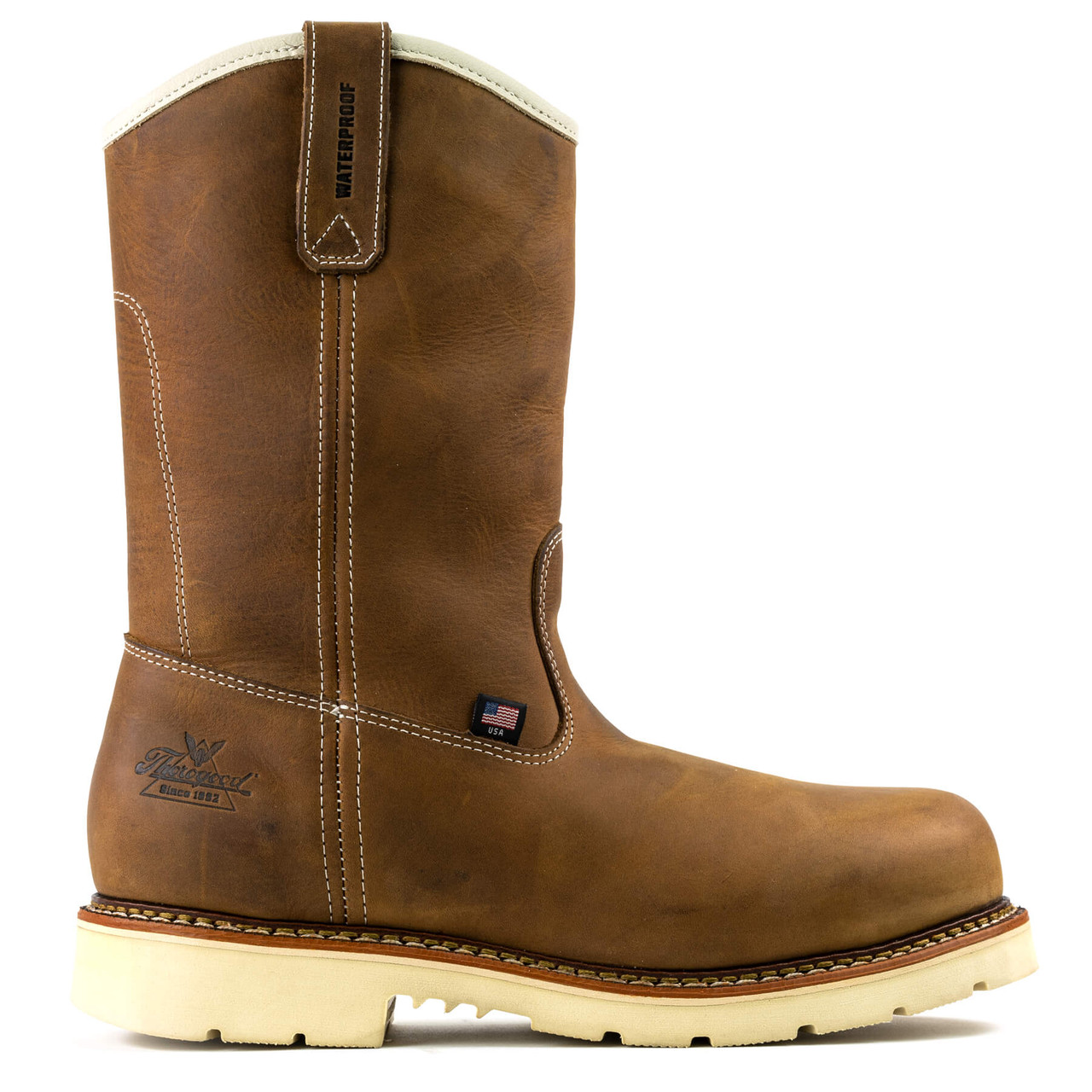
But the best Wellington work boots are much more than convenient slip-on footwear. The right pair can provide waterproof protection, safety-toe protection, slip resistance, cushioning and the durability needed for construction sites, farms, ranches, factories, workshops and outdoor jobs.
The wrong pair?
Well, let’s just say your feet may file a formal complaint before lunchtime.
In this updated guide, we’re looking at the best Wellington work boots for 2026, including leather pull-ons, waterproof rubber boots, safety-toe models and options for wet, muddy and demanding work.
Best Wellington Work Boots: Quick Picks
| Boot | Best For | Standout Feature |
|---|---|---|
| Thorogood American Heritage Wellington | Best overall | Premium leather, comfort and traditional construction |
| Wolverine Floorhand Wellington | Best waterproof leather | Waterproof leather, steel toe and pull-on convenience |
| Georgia Steel Toe Wedge Wellington | Best construction value | Steel toe, wedge sole and rugged leather |
| Muck Arctic Pro | Best extreme cold and wet weather | Insulated waterproof rubber construction |
| BOGS Workman | Best wet-weather safety boot | Waterproof construction and composite safety protection |
| XTRATUF Ankle Deck Boot | Best lightweight wet-weather pull-on | Waterproof and slip-resistant design |
| Thorogood MAXWear Wedge Wellington | Best for hard floors | Cushioned wedge platform |
If slippery floors are part of your everyday job, also check out our guide to the best oil- and slip-resistant work boots.
What Is a Wellington Work Boot?
A Wellington work boot is essentially a pull-on boot with a taller shaft. Unlike lace-up boots, it uses pull tabs, side openings or a flexible shaft to make getting the boot on and off much faster.
The design became famous through the style associated with Arthur Wellesley, the Duke of Wellington. Today, however, the Wellington has evolved far beyond traditional dress footwear.
Modern Wellington work boots can include:
- Steel or composite safety toes
- Electrical-hazard protection
- Waterproof membranes
- Rubber or polyurethane construction
- Oil- and slip-resistant outsoles
- Wedge soles
- Heavy-duty leather uppers
- Insulation for cold weather
- Metatarsal protection on selected models
That makes the style surprisingly versatile.
Why Choose Wellington Work Boots?
The biggest advantage is obvious: they are incredibly easy to put on and remove.
Imagine finishing a muddy shift and realizing you have to untie eight lace loops before getting into your truck.
Now imagine simply pulling your boots off.
That’s the Wellington advantage.
Easy On and Easy Off
Pull-on boots are especially useful for farmers, ranchers, mechanics, construction workers and anyone who frequently moves between clean and dirty environments.
Excellent Wet-Weather Coverage
A tall Wellington shaft provides more coverage than a low work shoe. Rubber and waterproof leather models can be particularly useful around mud, puddles, wet grass and other messy conditions.
Fewer Things to Break
No shoelaces means no broken shoelaces.
No eyelets means fewer eyelets to damage.
It’s not exactly rocket science, but simple designs can be surprisingly effective.
Great for Quick Changes
If your job requires you to remove footwear frequently, a pull-on boot can save a surprising amount of time.
For workers who spend long hours on their feet, comfort matters just as much as convenience. Our guide to the best work boots for plantar fasciitis covers some of the most important comfort features to look for.
1. Thorogood American Heritage Wellington — Best Overall

If you want a Wellington that feels like a serious traditional work boot rather than a glorified rain boot, the Thorogood American Heritage Wellington is an excellent place to start.
Thorogood’s American Heritage Wellington range includes several versions, including safety-toe, waterproof and wedge-sole configurations.
The waterproof safety-toe model combines full-grain leather with a waterproof membrane, a removable cushioned footbed, Goodyear storm-welt construction and a slip-resistant outsole.
That combination gives this Wellington something many pull-on boots lack: a genuine work-boot feel.
Why We Like It
- Traditional 11-inch Wellington profile
- Full-grain leather
- Safety-toe versions available
- Waterproof version available
- Removable cushioned footbed
- Goodyear storm-welt construction
- Slip-resistant outsole options
- Made in the USA on selected models
It’s especially appealing for construction workers and tradespeople who spend most of their day on hard surfaces but still want pull-on convenience.
Thorogood also offers a plain-toe MAXWear Wedge Wellington, which is an interesting choice for workers who prioritize cushioning and stability over a safety toe.
See the current Thorogood American Heritage Wellington range
2. Wolverine Floorhand Wellington — Best Waterproof Leather Option

The Wolverine Floorhand Wellington is a strong choice if you like the traditional leather look but need waterproofing and safety protection.
The current Floorhand Wellington uses waterproof full-grain leather, a moisture-managing lining, a removable cushioned footbed and a rubber lug outsole.
There’s also a steel safety toe and an ASTM-rated safety specification on the current model.
That makes it much more than an ordinary pull-on boot.
Best Features
- Waterproof full-grain leather
- Steel safety toe
- Removable cushioned footbed
- Rubber lug outsole
- Moisture-managing lining
- Pull-on Wellington design
- Designed for work and outdoor use
The lug outsole makes it more appealing for workers who regularly leave flat concrete surfaces and move onto dirt, gravel or uneven ground.
If you need a traditional leather Wellington that can handle wet conditions, this one deserves a serious look.
Check Wolverine’s current Wellington work boot range
For more rugged leather alternatives, compare it with our best Red Wing work boots guide.
3. Georgia Steel Toe Wedge Wellington — Best for Construction

For construction workers who spend much of their day walking or standing on concrete, the Georgia Steel Toe Wedge Wellington is a very interesting option.
The G5353 uses Georgia’s SPR leather, a steel toe, steel shank, cushioned insole and wedge-style outsole.
The wedge platform is particularly appealing on flat, hard surfaces because it creates a broad contact area beneath the foot.
That doesn’t mean every worker will love a wedge sole. Some people prefer a defined heel and aggressive lugs, especially when working outdoors.
But if your workday looks like:
- Concrete floors
- Warehouse aisles
- Construction slabs
- Manufacturing facilities
- Indoor industrial environments
a wedge Wellington can be a very comfortable setup.
Why It Stands Out
- Steel safety toe
- Electrical-hazard protection
- SPR leather
- Steel shank
- Cushioned insole
- Oil- and chemical-resistant outsole
- Goodyear welt construction
- Pull-on tabs
It’s also a useful option for workers who want a traditional leather boot without dealing with laces.
For more construction-specific footwear ideas, see our guide to the best work boots for welding.
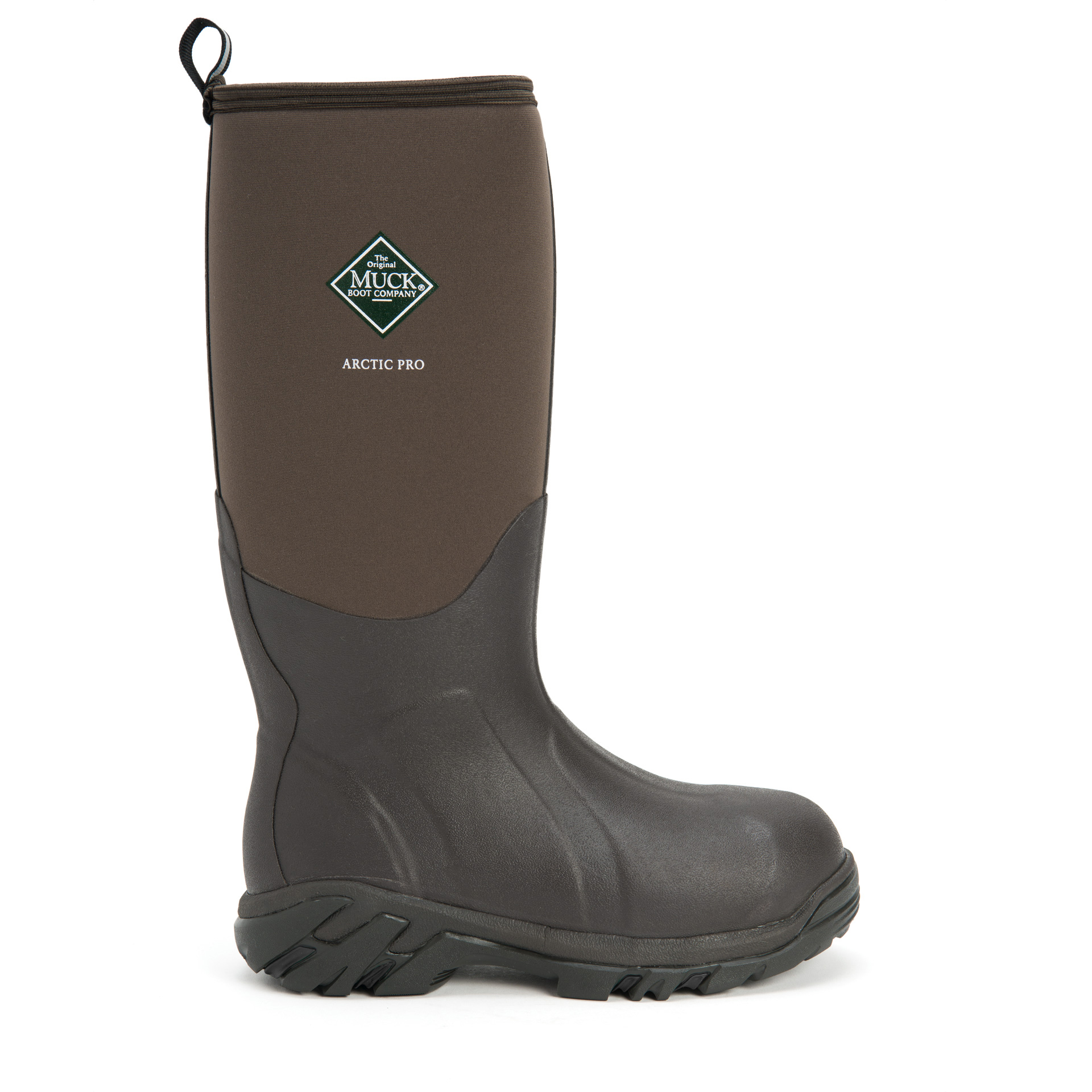
4. Muck Arctic Pro — Best for Extreme Cold and Wet Weather
Sometimes leather isn’t the answer.
Sometimes you’re standing in mud, snow, slush or water and need something that behaves more like a personal waterproof fortress.
That’s where the Muck Arctic Pro comes in.
This tall rubber work boot is designed for extremely cold and wet conditions, using heavy insulation and a waterproof construction.
It’s especially attractive for agricultural workers, outdoor crews, hunters, ranchers and anyone working in genuinely miserable winter weather.
Why Choose It?
- 100% waterproof construction
- Heavy insulation
- Cold-weather design
- Tall shaft
- Aggressive traction
- Easy to rinse clean
There is one major thing to remember, though.
This is not automatically a substitute for an ASTM-rated safety-toe work boot.
If your workplace requires protective toes or electrical-hazard footwear, choose a model that specifically carries the required certification.
For muddy farm and ranch work, our farm and ranch work boot guide has more options.
5. BOGS Workman — Best Wet-Weather Safety Wellington
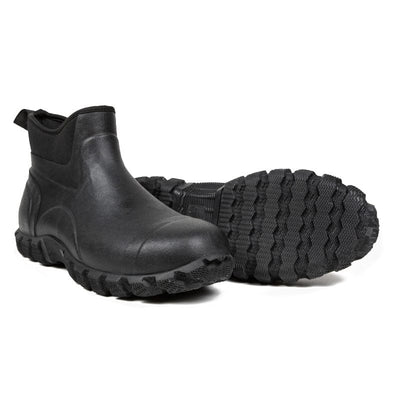
The BOGS Workman is aimed at workers who need more than simple rain protection.
The Workman range combines waterproof construction with work-focused protection. Current versions include composite safety-toe and puncture-resistant plate configurations, making them much more relevant to industrial and wet-weather work than ordinary rain boots.
That combination is useful for workers who spend time around mud, water, farms, landscaping operations or other wet environments.
Best Features
- Waterproof construction
- Composite safety-toe options
- Puncture-resistant protection on selected models
- Moisture-management features
- Cushioned footbed
- Slip-resistant outsole
- Easy-clean exterior
The biggest advantage of a rubber-style Wellington is obvious after about five seconds in a muddy field.
You can wash it.
Try doing that with your favorite suede work boot.
Exactly.
6. XTRATUF Ankle Deck Boot — Best Lightweight Wet-Weather Pull-On
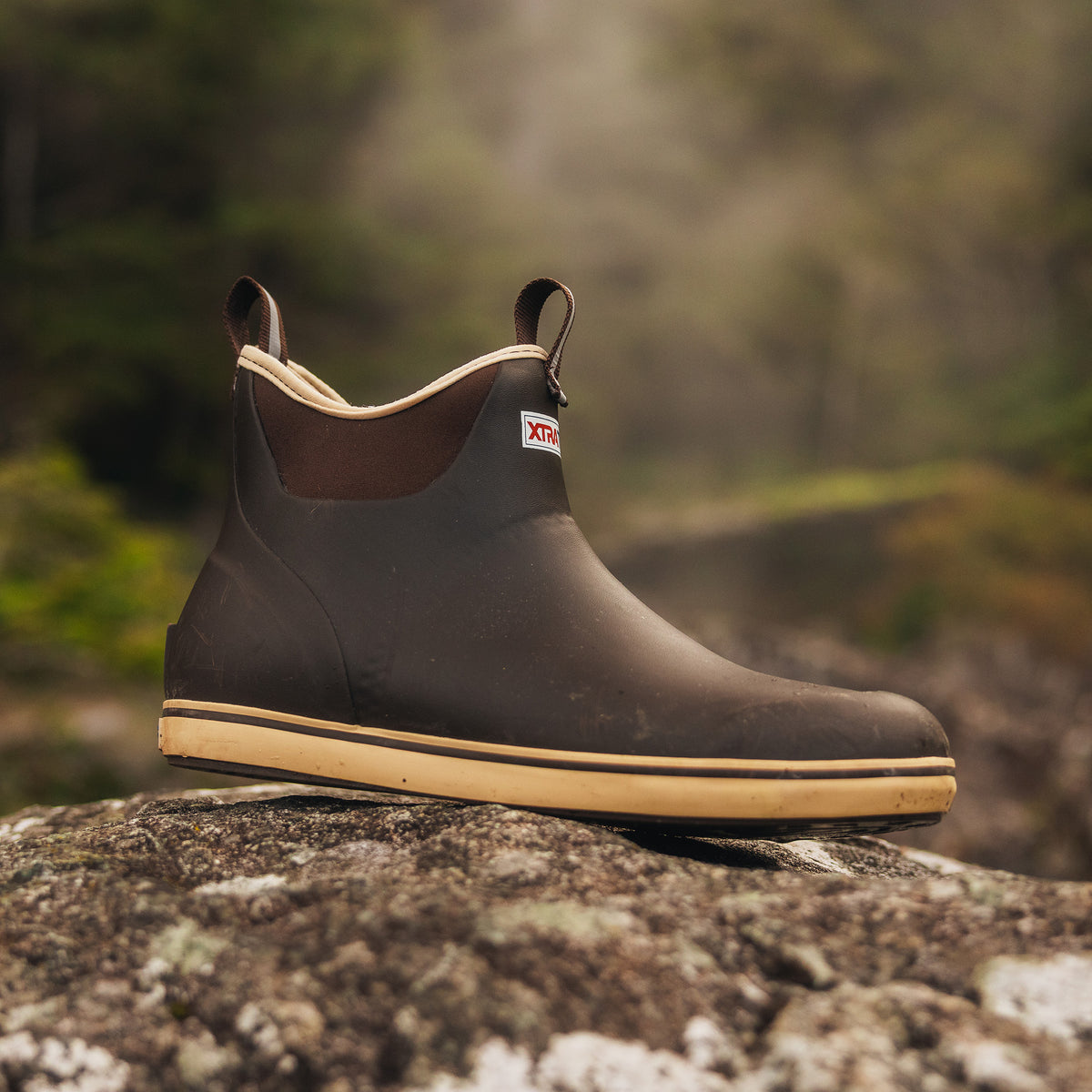
The XTRATUF Ankle Deck Boot is a little different from the tall Wellingtons above.
It is shorter, lighter and designed primarily around wet-weather traction and waterproofing.
XTRATUF describes this model as 100% waterproof and gives it a slip-resistant, non-marking Chevron outsole.
That makes it interesting for fishing, marine work, landscaping, gardening and wet-weather chores where you don’t necessarily need a steel toe.
Important Safety Note
This is not the boot to choose when your workplace requires a certified safety toe.
Instead, think of it as a lightweight waterproof pull-on for wet environments where that level of industrial protection isn’t required.
Its shorter shaft also makes it easier to move around in compared with knee-high rubber boots.
7. Thorogood MAXWear Wedge Wellington — Best for Hard Floors
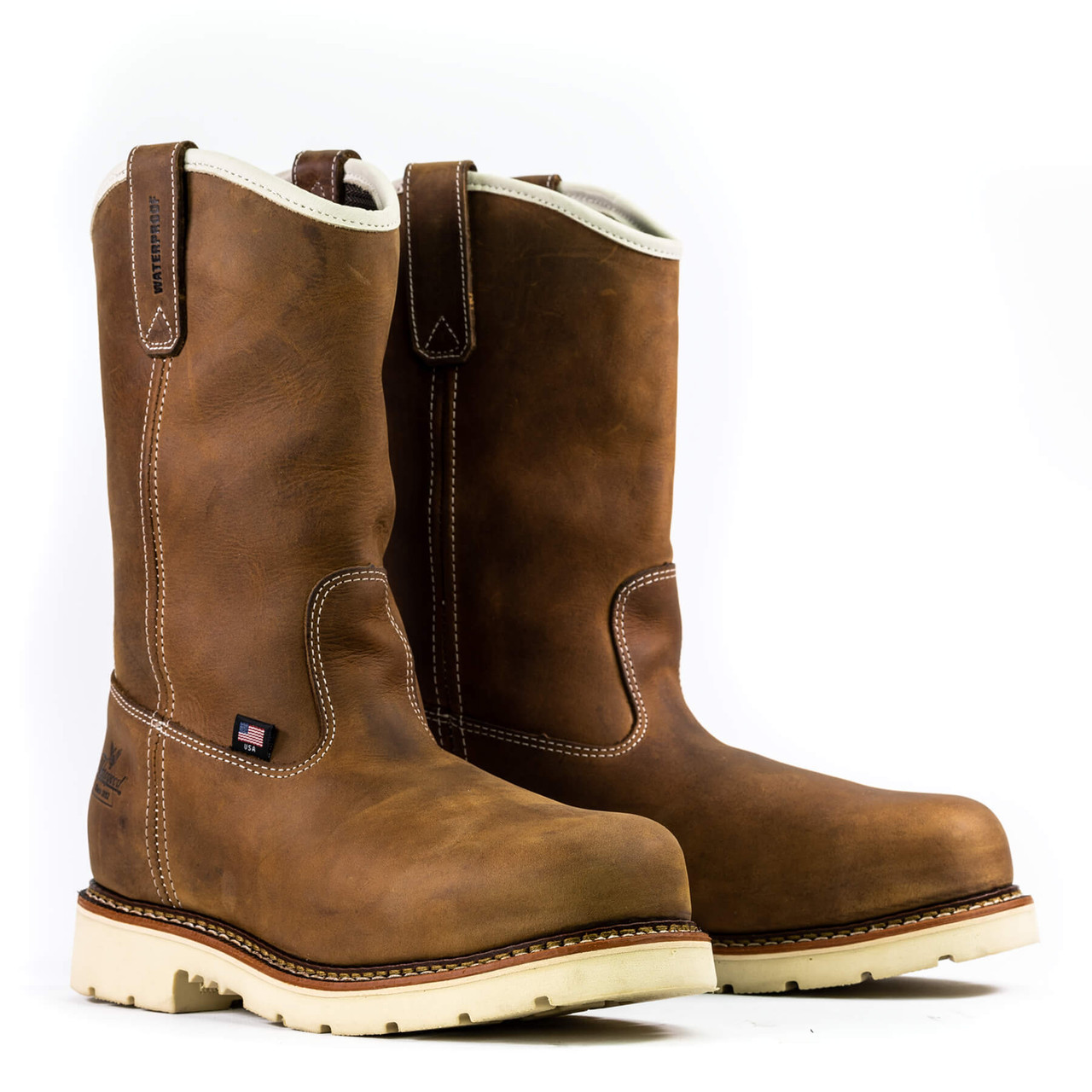
If your daily work surface is mostly concrete, the Thorogood MAXWear Wedge Wellington deserves special attention.
The wedge outsole creates a broad, relatively flat platform beneath the boot. Combined with a cushioned footbed, it can provide a comfortable feel for long periods of standing and walking on flat surfaces.
Thorogood offers the MAXWear Wedge Wellington in both safety-toe and plain-toe configurations.
The plain-toe version is particularly interesting for workers whose jobs don’t require a safety toe.
Best For
- Construction workers
- Carpenters
- Warehouse workers
- Manufacturing employees
- Indoor industrial jobs
- Long hours on concrete
For workers with foot discomfort, the combination of a supportive footbed and a stable outsole can be more important than simply choosing the softest boot available.
If you’re dealing with flat feet, take a look at our guide to the best work boots for flat feet.
Leather vs. Rubber Wellington Work Boots
This is one of the most important decisions you’ll make.
Choose Leather If You Mostly Work On:
- Concrete
- Construction sites
- Factories
- Warehouses
- Workshops
- Mixed indoor and outdoor surfaces
Leather Wellingtons generally feel more like traditional work boots. They can offer structured support, safety-toe options and resoleable construction on selected models.
Choose Rubber If You Mostly Work In:
- Mud
- Standing water
- Wet grass
- Manure
- Rain
- Snow
- Very wet agricultural environments
Rubber boots are easier to clean and naturally suited to wet conditions.
The trade-off is that some rubber Wellington boots don’t provide the same support, breathability or safety certifications as dedicated leather safety work boots.
So don’t simply ask, “Which material is better?”
Ask, “What am I actually walking through every day?”
Steel Toe vs. Composite Toe Wellington Boots
If your workplace requires a safety toe, you’ll generally encounter steel and composite options.
Steel Toe
Steel has a long history in protective footwear and offers strong impact and compression protection. It can also be relatively compact inside the toe area.
The downside is that steel can add weight and may feel colder in very cold conditions.
Composite Toe
Composite safety toes can be lighter than steel and don’t conduct temperature in exactly the same way.
They’re often attractive to electricians, outdoor workers and anyone who spends a lot of time walking.
However, don’t assume “composite” automatically means better. The right choice depends on the workplace hazards and required certification.
For more safety-toe choices, visit our steel toe work boots collection.
What Does EH Mean on a Work Boot?
EH generally refers to electrical-hazard protection in work-footwear specifications.
If your job involves electrical hazards, don’t rely on a boot simply because the manufacturer calls it a “work boot.” Check the actual safety markings and certification for the specific model.
And remember: protective footwear is only one part of an electrical safety program.
For specialized welding footwear, our welding work boot guide is worth reading before you buy.
What Does Slip-Resistant Mean?
A slip-resistant outsole is designed to improve traction on surfaces where ordinary soles may struggle.
But there is no magic boot that makes every surface safe.
Oil, water, mud, grease, ice and smooth concrete can all behave differently.
That’s why outsole design matters.
Look for a tread pattern and rubber compound appropriate for your working environment.
If your job involves oil or grease, don’t miss our detailed guide to oil- and slip-resistant work boots.
How Should a Wellington Work Boot Fit?
This is where many Wellington buyers make a mistake.
Because there are no laces, you can’t tighten the boot around your foot the way you can with a lace-up boot.
That means fit is extremely important.
Your Heel Should Stay Secure
A small amount of heel movement can happen with new pull-on boots, but excessive movement is a warning sign.
If your heel lifts dramatically with every step, the boot may not be the right shape for your foot.
Your Toes Need Room
Your toes should not press hard against the front of the boot.
Remember that feet can swell during long workdays, so the fit that feels perfect at 7 a.m. may feel completely different at 4 p.m.
The Instep Matters
This is especially important with pull-on boots.
If the boot is extremely difficult to pull over your instep, you may have the wrong size or shape.
If it slides on and off with almost no resistance, the boot may not hold your foot securely enough.
Are Wellington Work Boots Good for Plantar Fasciitis?
They can be, but it depends heavily on the individual boot.
A Wellington with a supportive footbed, good cushioning and stable heel platform can be comfortable for someone who spends long hours standing.
A basic rubber Wellington with a thin, flat footbed may be a completely different story.
If heel pain is a major concern, look for:
- Removable insoles
- Supportive footbeds
- Good cushioning
- Stable heel construction
- A comfortable heel-to-toe transition
- Enough interior space for an appropriate orthotic if needed
Don’t assume that every pull-on boot is automatically comfortable just because it feels soft.
For more information, see our plantar fasciitis work boot guide.
Are Wellington Boots Good for Farmers and Ranchers?
Absolutely — provided you choose the right type.
Farm and ranch work is practically a greatest-hits album of things boots hate:
- Mud
- Water
- Manure
- Uneven ground
- Sharp objects
- Long walking distances
- Cold mornings
- Hot afternoons
Rubber and waterproof Wellington boots can be excellent for wet and muddy agricultural work.
For more farm-focused recommendations, check our best farm and ranch work boots.
Are Wellington Boots Good for Construction?
They can be excellent for construction, particularly when you’re working on relatively flat surfaces or in wet conditions.
Leather safety-toe Wellingtons are particularly useful when you need:
- Impact protection
- Electrical-hazard protection
- Slip resistance
- Water resistance
- Quick on/off convenience
- Long-shift comfort
Wedge-sole Wellingtons are particularly interesting for workers spending much of their day on concrete.
For general construction clothing and equipment, explore the work clothing section.
How to Make Wellington Work Boots More Comfortable
Wear the Right Work Socks
Good work socks can reduce friction, manage moisture and add a little extra cushioning.
Use an Appropriate Insole
If the boot has a removable footbed, you may be able to replace it with a more supportive insole that suits your foot.
Break Leather Boots In Gradually
Don’t buy a new pair of leather Wellingtons on Sunday and immediately wear them for a 12-hour shift on Monday.
Your feet will remember that decision.
Forever.
Keep Rubber Boots Dry Between Shifts
Even waterproof boots can become unpleasant if moisture and sweat remain trapped inside them.
Let them dry properly between workdays.
Replace Worn Footbeds
When an insole becomes flattened and compressed, it may no longer provide the same comfort it did when new.
How to Care for Leather Wellington Work Boots
Leather boots can last a very long time when cared for properly.
Clean Dirt Regularly
Brush away dried mud before it becomes permanently attached to the leather.
Condition the Leather
Use a conditioner appropriate for the specific leather. Over-conditioning can be just as undesirable as never conditioning at all.
Dry Them Naturally
Avoid aggressively heating leather boots with a radiator, heater or hair dryer.
Excessive heat can dry leather and damage adhesives or other components.
Inspect the Outsole
If the tread is heavily worn, traction can suffer even when the upper still looks fantastic.
A boot that looks like a million dollars but grips like a banana peel isn’t exactly a bargain.
How to Clean Rubber Wellington Work Boots
Rubber Wellingtons are considerably easier.
Usually, a rinse with clean water and a soft brush is enough to remove mud and dirt.
For stubborn grime, use a mild cleaner suitable for the boot material.
Allow the inside to dry completely before storing them.
This is one of the biggest advantages of rubber work boots: they’re happy to get dirty.
They practically expect it.
Wellington Work Boots vs. Lace-Up Work Boots
| Feature | Wellington | Lace-Up |
|---|---|---|
| Putting on | Very quick | Slower |
| Adjustability | Limited | Excellent |
| Wet protection | Excellent on many models | Depends on construction |
| Fit customization | More limited | Highly adjustable |
| Mud cleaning | Excellent on rubber models | Varies |
| Safety-toe options | Widely available | Widely available |
When Should You Choose a Wellington?
A Wellington is probably worth considering if you answer “yes” to several of these questions:
- Do you frequently work around mud or water?
- Do you hate tying boot laces?
- Do you frequently change footwear?
- Do you need a tall waterproof shaft?
- Do you work on a farm or ranch?
- Do you work in construction or industrial environments?
- Does your job require quick on-and-off footwear?
- Do you prefer traditional pull-on boots?
If most of your answers are yes, the Wellington style makes a lot of sense.
When Should You Avoid Wellington Work Boots?
They’re not perfect for every situation.
You may prefer a lace-up boot if:
- Your feet require very precise fit adjustment.
- You have unusual ankle or instep dimensions.
- You frequently climb ladders and need maximum ankle lockdown.
- Your job requires a very specific type of metatarsal protection.
- You simply find pull-on boots uncomfortable.
There’s no prize for wearing a Wellington if a different boot fits your foot and job better.
Best Wellington Work Boots by Job
| Job | Best Style | Why |
|---|---|---|
| Construction | Leather safety-toe Wellington | Protection, durability and easy on/off |
| Concrete work | Wedge Wellington | Broad underfoot platform |
| Farm work | Rubber Wellington | Waterproof and easy to clean |
| Ranch work | Leather or rubber Wellington | Depends on terrain and moisture |
| Fishing | Waterproof rubber pull-on | Traction and water protection |
| Cold outdoor work | Insulated rubber Wellington | Warmth and waterproofing |
| Warehouse work | Leather wedge Wellington | Comfort on hard floors |
Frequently Asked Questions
What are the best Wellington work boots?
The Thorogood American Heritage Wellington is our top overall choice because it combines traditional work-boot construction, pull-on convenience, cushioning and multiple safety configurations. The Wolverine Floorhand and Georgia Steel Toe Wedge are also excellent options depending on your work environment.
Are Wellington boots good for construction?
Yes. Leather safety-toe Wellingtons can be excellent for construction, especially when you need quick on/off convenience, water resistance, slip resistance and a protective toe.
Are Wellington work boots waterproof?
Some are, and some aren’t. Rubber Wellingtons are naturally well suited to wet conditions, while leather models may use waterproof membranes or treatments. Always check the specifications of the exact model.
Are Wellington boots good for walking all day?
They can be. Look for a supportive footbed, appropriate cushioning and a stable outsole. A wedge Wellington can be particularly comfortable for workers who spend long hours on flat concrete surfaces.
Can Wellington work boots have steel toes?
Yes. Many leather Wellington work boots are available with steel safety toes. Some rubber and synthetic models also offer composite or steel safety protection.
Are rubber Wellington boots better than leather?
Neither is automatically better. Rubber is excellent for mud, water and easy cleaning, while leather often provides a more traditional work-boot feel, structured support and a wider range of industrial safety configurations.
What is the best Wellington work boot for farmers?
For wet and muddy farm work, a waterproof rubber Wellington such as a Muck or BOGS model can be a strong choice. For mixed farm work involving hard surfaces and safety-toe requirements, a leather safety Wellington may be better.
What is the best Wellington work boot for concrete?
A wedge-sole leather Wellington is worth considering if you spend most of your shift on flat concrete. The broad sole and cushioned footbed can provide a comfortable underfoot feel.
Are Wellington boots good for plantar fasciitis?
They can be if the particular model provides appropriate cushioning, support and fit. However, plantar fasciitis is a medical condition, and work boots should not be considered a guaranteed treatment or cure.
How tight should Wellington work boots be?
They should feel secure without squeezing your foot. Your heel shouldn’t move excessively, and your toes need enough room to move naturally.
Final Ranking: Best Wellington Work Boots for 2026
- Thorogood American Heritage Wellington — Best overall
- Wolverine Floorhand Wellington — Best waterproof leather option
- Georgia Steel Toe Wedge Wellington — Best for construction
- Muck Arctic Pro — Best for extreme cold and wet weather
- BOGS Workman — Best wet-weather safety Wellington
- XTRATUF Ankle Deck Boot — Best lightweight wet-weather pull-on
- Thorogood MAXWear Wedge Wellington — Best for long hours on hard floors
So, Which Wellington Work Boot Should You Buy?
If you want one pair that covers the widest range of traditional work applications, start with the Thorogood American Heritage Wellington.
If waterproof leather and a safety toe are your priorities, the Wolverine Floorhand is a strong choice.
If you spend most of your day on concrete, look closely at the Georgia Steel Toe Wedge Wellington or a Thorogood wedge model.
If you’re fighting mud, standing water and brutally cold weather, a rubber Wellington such as the Muck Arctic Pro makes much more sense.
If you need wet-weather protection combined with workplace safety features, the BOGS Workman deserves attention.
And if your job is wet but doesn’t require a safety toe, the lightweight XTRATUF Ankle Deck Boot is an interesting alternative.
The important thing is to match the boot to the job.
Don’t buy a tall rubber boot because it looks tough if you spend ten hours a day on concrete.
Don’t buy a beautiful leather Wellington if you’re standing in ankle-deep mud every morning.
And don’t buy a comfortable-looking boot that doesn’t meet your workplace’s safety requirements.
The best Wellington work boot is the one that fits your feet, matches your hazards and makes the workday easier.
And perhaps the best part?
When the shift ends, you can pull them off without touching a single shoelace.
Sometimes the little victories are the best ones.
More Work Boot Guides
Looking for more ways to upgrade your work footwear? Compare our best Red Wing work boots, explore the best oil- and slip-resistant boots, or check our recommendations for farm and ranch work boots.
If comfort is your biggest priority, read our guides to work boots for plantar fasciitis and work boots for flat feet.
For specialized work environments, see our best welding work boots guide and browse our steel toe work boots collection.
If you’re putting together a complete jobsite outfit, explore the site’s work clothing section. And after a long day on the job, don’t forget the lunch setup — our guide to the best lunch coolers for construction workers has you covered.
Image Credits
Images are credited individually beneath each image. Product images are used from the corresponding product retailers or manufacturers for identification and editorial review. Product availability, materials, safety certifications and specifications can change, so always check the current manufacturer’s information for the exact model before purchasing.
Safety note: Always choose work footwear according to the hazards and safety requirements of your workplace. A waterproof or rugged Wellington is not automatically a safety boot, and not every model provides a protective toe, electrical-hazard protection or other required certification.
1 thought on “Best Wellington Work Boots in 2026: 7 Tough Pull-On Boots for Construction, Farms, Wet Jobs and Long Shifts”