Video credit: Silver Cymbal / YouTube — “How to Mow a Lawn CORRECTLY.”
Cutting grass looks easy until you actually spend an hour doing it.
The sun is blazing. The lawn is damp. Grass clippings are everywhere. Your feet are sweating. And somehow that old pair of sneakers you thought would be “good enough” has turned into two portable saunas.
There is a better way.

The best shoes for cutting grass should give you a combination of comfort, traction, protection and weather resistance without feeling unnecessarily heavy.
That last part matters. You don’t necessarily need a giant pair of construction boots just to mow a suburban lawn. But you also don’t want thin running shoes when wet grass, stones, sticks and mower debris are part of the equation.
So what should you actually wear?
After revisiting the classic lawn-mowing footwear recommendations and looking at today’s outdoor, landscaping and work-footwear options, we’ve put together this updated guide to the best shoes for mowing grass in 2026.
Best Shoes for Cutting Grass: Quick Comparison
| Footwear | Best For | Why It Stands Out |
|---|---|---|
| Kujo Yard Shoes | Best overall lawn-mowing shoe | Athletic comfort with yard-work protection |
| Timberland PRO Direct Attach | Best heavy-duty option | Waterproofing, traction and safety-toe versions |
| Merrell Moab 3 GORE-TEX | Best comfortable hiking shoe | Waterproofing, cushioning and outdoor traction |
| XTRATUF Ankle Deck Boot | Best wet grass footwear | Waterproof and slip-resistant |
| Kujo X1 Landscape Boot | Best professional landscaping option | Traction, protection and breathable construction |
| Thorogood Wellington | Best pull-on work boot | Easy on/off and rugged leather construction |
| Rocky-style waterproof work boot | Best for cold-weather mowing | Warmth, waterproofing and rugged traction |
If you’re doing more than mowing and also handle landscaping, mud or farm work, check out our guide to the best farm and ranch work boots.
Why You Shouldn’t Mow the Lawn in Regular Sneakers
Let’s be honest. We’ve all done it.
You see the lawn needs cutting, grab your old sneakers and think, “I’ll only be out there for 30 minutes.”
Two hours later, your shoes are wet, covered in grass and smelling like they’ve spent the weekend living behind a compost bin.
There is also a safety issue.
Lawn mowers can throw small rocks, sticks and other debris. Outdoor safety guidance recommends sturdy, non-slip footwear rather than sandals or ordinary sneakers when operating power lawn equipment.
In fact, the Canadian Centre for Occupational Health and Safety recommends non-slip safety-toe footwear when operating rotary power lawn mowers. You can read the CCOHS lawn-mower safety guidance.
Oklahoma State University Extension also recommends sturdy work boots and notes that steel-toe boots can help protect the feet from dropped or thrown objects.
See Oklahoma State University’s lawn-care safety recommendations.
What Makes the Best Shoes for Cutting Grass?

The ideal lawn-mowing shoe depends on your lawn, climate and mower. Still, several features consistently matter.
1. Good Traction
Wet grass can be surprisingly slippery.
If you’ve ever tried walking quickly across freshly watered grass, you already know it can feel like nature installed a miniature ice rink.
A good outsole should provide reliable grip without being so aggressive that grass and mud become permanently attached to your shoes.
2. Water Resistance
Morning dew can soak through lightweight sneakers surprisingly quickly.
If you mow early in the morning, waterproof or water-resistant footwear can make a huge difference.
3. Comfort
Mowing isn’t always a quick job. Large lawns, uneven terrain and professional landscaping work can keep you on your feet for hours.
Cushioning and a supportive footbed become increasingly important as the mowing session gets longer.
4. Breathability
Waterproof is great.
Waterproof and completely suffocating is less great.
For hot climates, look for breathable mesh, moisture-managing linings or footwear designed specifically for outdoor work.
Our guide to the best breathable work boots has more options for hot working conditions.
5. Protection
You don’t necessarily need a steel toe for every backyard mowing job, but some level of foot protection is a sensible idea when you’re operating powered equipment.
For commercial lawn care, landscaping or jobs involving heavy equipment, a safety toe may be particularly worthwhile.
6. Flexibility
Your feet move differently when you’re walking behind a mower, stepping onto a riding mower or navigating around trees and flower beds.
Extremely bulky boots can become annoying quickly.
7. Easy Cleaning
Grass clippings have an almost supernatural ability to find every corner of your footwear.
Easy-to-clean materials are a blessing.
1. Kujo Yard Shoes — Best Overall for Cutting Grass
If you want something that sits between a sneaker and a work boot, Kujo Yard Shoes are one of the most interesting choices for lawn mowing.
The idea is simple: give outdoor workers the comfort and flexibility of athletic footwear while adding features designed for grass, dirt and yard work.
The result is a shoe that looks much more natural on a lawn than a huge industrial boot.
Why We Like Them
- Athletic-style feel
- Designed specifically around yard work
- Good traction for grass and outdoor surfaces
- More protection than an ordinary sneaker
- Useful for mowing and general landscaping
- Good choice for homeowners and professionals
The big advantage is versatility.
You can mow the lawn, trim the edges, move garden equipment and handle general outdoor chores without feeling as though you’re wearing a pair of industrial tanks.
For someone who spends every Saturday morning battling an overgrown backyard, this is exactly the kind of footwear that makes sense.
2. Timberland PRO Direct Attach — Best Heavy-Duty Lawn-Mowing Boot

If your lawn care involves more than mowing a small residential yard, stepping up to a proper work boot can be worthwhile.
The Timberland PRO Direct Attach family includes waterproof work boots with slip-resistant outsoles, comfort footbeds and both safety-toe and soft-toe configurations depending on the model.
Current Direct Attach models are designed for demanding work environments, with waterproof leather, traction-focused rubber outsoles and cushioning aimed at long days on your feet.
Best For
- Professional landscapers
- Large properties
- Wet weather
- Rough terrain
- Commercial lawn care
- Workers who need safety-toe options
They are heavier than ordinary lawn shoes, so they may be overkill for someone mowing a tiny suburban lawn twice a month.
But when mowing is part of your job, that extra protection starts looking much more attractive.
For more heavy-duty options, browse our steel toe work boots collection.
3. Merrell Moab 3 GORE-TEX — Best Comfortable Waterproof Shoe

If comfort is your number-one priority and you don’t need a safety toe, a hiking shoe can be a surprisingly good lawn-mowing choice.
The Merrell Moab 3 GORE-TEX is a strong example.
Merrell’s current version uses a GORE-TEX waterproof membrane, breathable mesh, a supportive footbed, an air-cushioned heel and a Vibram TC5+ outsole with 5 mm lugs.
That’s a lot of hiking technology for mowing grass.
But here’s the thing: lawns are outdoor terrain.
Uneven ground, slopes, wet grass and roots don’t care whether you’re hiking through a forest or walking behind a mower.
Why It Works for Mowing
- Waterproof GORE-TEX construction
- Breathable upper materials
- Comfortable footbed
- Shock-absorbing heel
- Good outdoor traction
- Relatively lightweight compared with many work boots
It’s especially appealing for homeowners who want one comfortable shoe that can handle mowing, gardening, walking and general outdoor activities.
For workers with foot-support concerns, compare it with our guide to the best work boots for flat feet.
4. XTRATUF Ankle Deck Boot — Best for Wet Grass

For wet lawns, rainy mornings and muddy gardens, XTRATUF Ankle Deck Boots are worth a look.
The current Ankle Deck Boot is built around a waterproof rubber construction and a slip-resistant Chevron outsole. It also includes an antimicrobial moisture-wicking liner and a molded BioLite footbed.
And because the boot is only around ankle height, you don’t get the giant-rubber-boot feeling that can make summer yard work miserable.
Why It’s a Great Wet-Grass Option
- 100% waterproof
- Slip-resistant Chevron outsole
- Moisture-wicking liner
- Lightweight design
- Pull-on tabs
- Good for wet outdoor environments
There is one catch.
The standard Ankle Deck Boot isn’t a safety-toe work boot. If your professional landscaping job requires certified toe protection, choose footwear that specifically meets those requirements.
For more waterproof pull-on options, see our best Wellington work boots guide.
5. Kujo X1 Landscape Boot — Best for Professional Landscapers
Professional landscapers have different needs from homeowners.
You may spend eight hours walking, mowing, trimming, loading equipment and working on slopes. In that situation, a basic sneaker simply isn’t enough.
The Kujo X1 Landscape Boot is designed specifically around landscaping work.
The X1 combines a composite safety toe with breathable materials, cushioning and a traction-focused outsole. It is aimed at workers who need a more protective shoe without the weight and stiffness of a traditional heavy-duty work boot.
Best Features
- Composite safety toe
- Breathable construction
- Cushioned midsole
- Deep traction lugs
- Designed for uneven outdoor terrain
- Useful for professional landscaping
This is the type of footwear to consider if mowing is your occupation rather than your Saturday hobby.
And if you’re moving between mowing, planting and other outdoor jobs, our best Red Wing work boots guide provides more rugged alternatives.
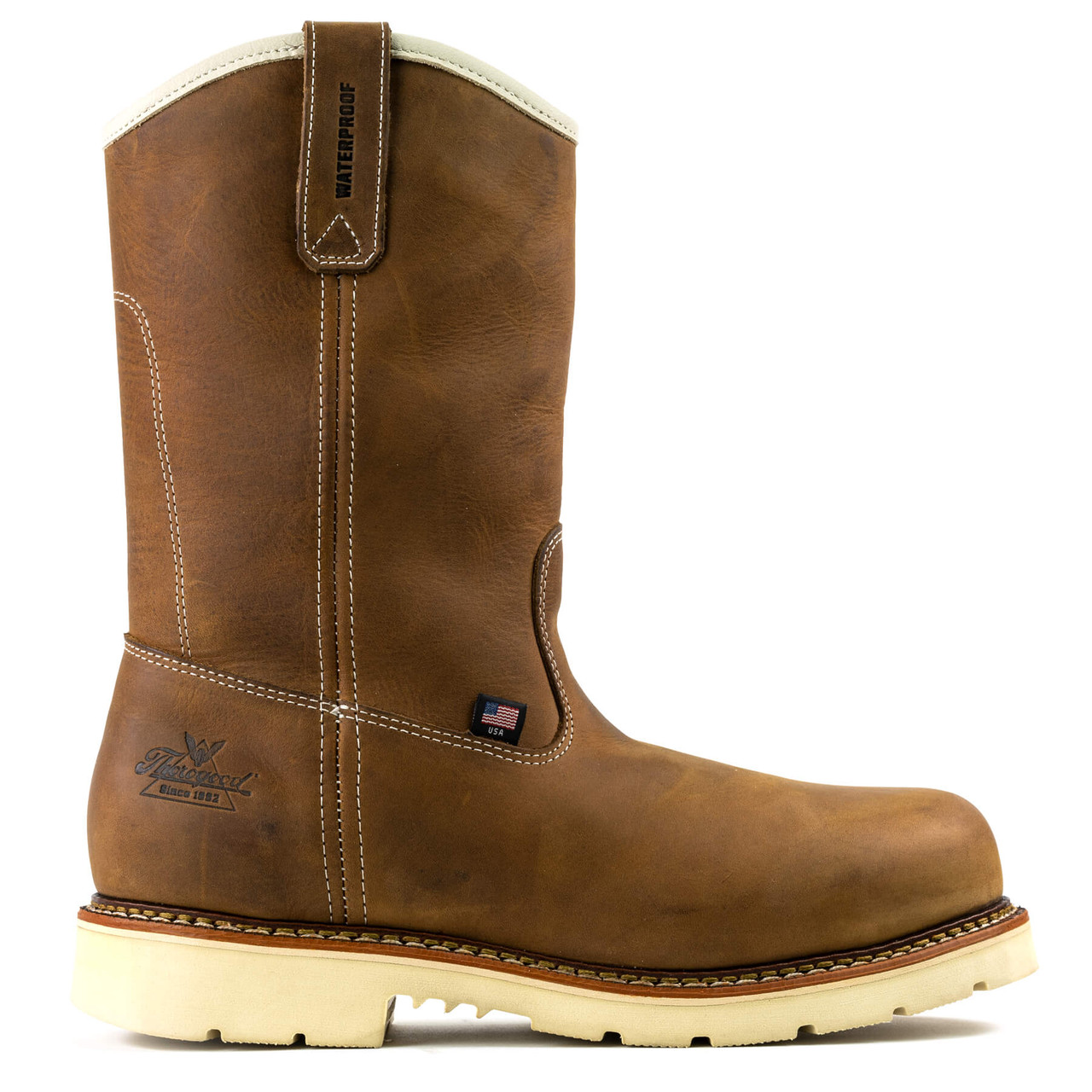
6. Thorogood Wellington — Best Pull-On Work Boot
Sometimes you don’t want another pair of shoes.
You want a boot.
A serious one.
The Thorogood Wellington style is particularly useful for people who work outdoors and want a tall leather boot with quick pull-on convenience.
Wellington boots can be a practical choice for mowing large properties, farm work and landscaping because there are no laces to worry about and the taller shaft offers additional coverage around the ankle and lower leg.
Why Consider a Wellington?
- Fast pull-on design
- No exposed shoelaces
- Tall shaft
- Traditional leather construction on many models
- Strong traction options
- Suitable for mixed outdoor work
They can be especially useful when your lawn is surrounded by mud, weeds, brush and other outdoor mess.
For wet and muddy work, compare different Wellington designs before buying. Some are optimized for traditional work, while others are primarily rain boots.
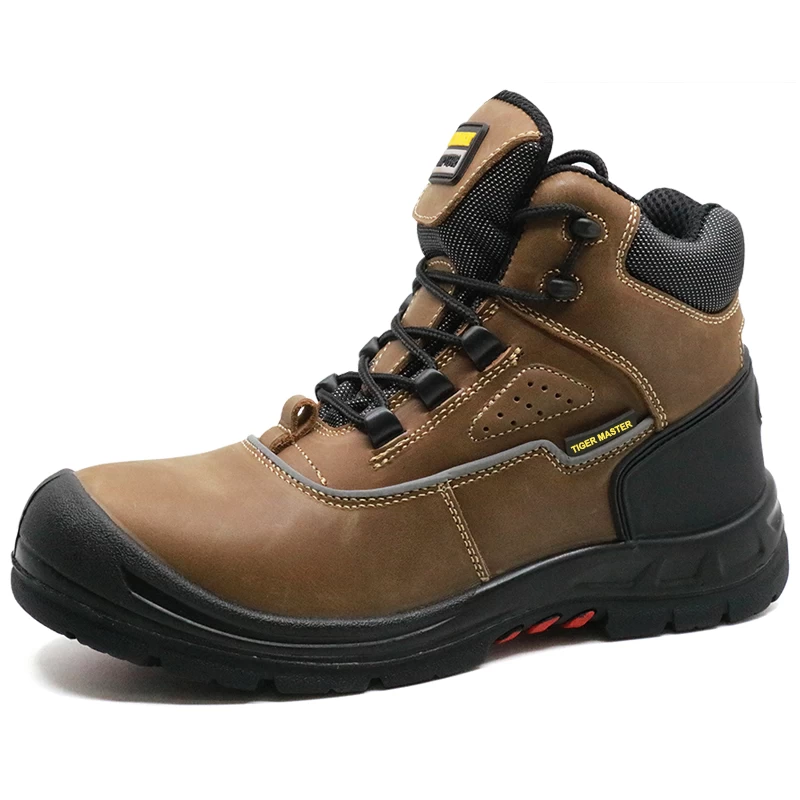
7. Rocky-Style Waterproof Work Boots — Best for Cold-Weather Mowing
Not everyone stops mowing when the temperature drops.
Some people apparently look at a cold, wet Saturday morning and think, “Perfect lawn-mowing weather.”
Respect.
For colder conditions, a waterproof insulated work boot can be a better choice than a lightweight lawn shoe.
The Rocky Iron Clad style represented in the original lawn-mowing guide is a good example of the traditional cold-weather approach: waterproof construction, insulation, rugged traction and a protective toe.
Best For
- Cold mornings
- Wet autumn weather
- Large properties
- Professional outdoor work
- Mud and rough terrain
The downside is obvious: insulation becomes your enemy when the temperature climbs.
If you’re mowing in 90°F weather, you probably don’t want 400 grams of insulation around your feet.
Should You Wear Steel-Toe Boots While Mowing?
For a small backyard lawn, a steel-toe boot may not be necessary for every person.
For professional landscaping and commercial lawn care, however, safety-toe footwear can make much more sense.
Mowers can encounter hidden rocks, sticks, metal fragments, landscaping tools and other objects.
Oklahoma State University Extension specifically recommends steel-toe boots while operating lawn mowers or string trimmers as an added layer of foot protection.
The right answer ultimately depends on your equipment, work environment and employer’s safety requirements.
Don’t assume that every safety toe is identical either. Look for the certification required for your workplace.
If you want to compare more safety-toe choices, visit our steel toe work boots category.
Waterproof vs. Breathable Shoes for Lawn Mowing
This is one of the biggest lawn-mowing footwear debates.
Choose Waterproof Footwear If:
- You mow early in the morning.
- Your lawn stays wet for long periods.
- You frequently work in rain.
- You deal with mud.
- You live in a wet climate.
Choose More Breathable Footwear If:
- You mostly mow during hot weather.
- Your lawn is usually dry.
- You sweat heavily.
- You spend several hours outside.
- You don’t need a tall waterproof boot.
There is no universal winner.
A waterproof boot is wonderful when your feet are standing in wet grass.
On a 95°F afternoon, however, a breathable outdoor shoe can feel like a completely different species of footwear.
What Shoes Are Best for Riding a Lawn Mower?
Riding mowers introduce a slightly different requirement.
You need footwear that is comfortable, secure and not excessively bulky around the pedals and controls.
A huge lugged boot may provide excellent traction while being awkward around certain mower controls.
On the other hand, a flimsy sneaker offers little protection.
Look for:
- Secure fit
- Moderate outsole flexibility
- Good grip
- Closed-toe protection
- Comfortable heel
- A profile that doesn’t interfere with controls
And always follow the mower manufacturer’s operating instructions.
What Shoes Are Best for Push Mowing?
Push mowing is more demanding than it looks.
You’re walking continuously, pushing the machine, turning, stopping and often dealing with slopes.
For that reason, traction and comfort become especially important.
A hiking shoe such as the Merrell Moab 3 GORE-TEX can make sense for dry or wet lawns where you don’t need a safety toe. A landscaping shoe such as the Kujo Yard Shoe can be even more directly suited to the task.
For professional work, step up to a safety-rated landscaping or work boot.
What About Lawn Mowing on Slopes?
Slopes change everything.
When you’re mowing on an incline, traction becomes much more important than appearance.
Look for an outsole with a dependable lug pattern and a secure heel fit.
A shoe that feels perfectly comfortable on flat grass may not provide the same confidence on a damp slope.
Never rely solely on footwear to make an unsafe mowing situation safe. Follow the mower’s operating instructions and the manufacturer’s recommendations for slopes.
Are Wellington Boots Good for Cutting Grass?
They can be excellent, especially when the grass is wet.
Traditional Wellington boots are waterproof, easy to clean and offer plenty of coverage.
The downside is that many rubber Wellingtons can feel hot, and some lack the cushioning or foot support needed for long periods of walking.
For short wet-weather jobs, they’re fantastic.
For eight hours of professional landscaping, a supportive landscaping shoe or work boot may be more comfortable.
Read our full guide to the best Wellington work boots before choosing a tall pull-on boot.
How to Choose the Right Lawn-Mowing Shoes for Your Feet
Your lawn isn’t the only thing you need to consider.
Your feet matter too.
Flat Feet
If you have flat feet, look for a supportive footbed and a stable midsole rather than simply choosing the softest shoe available.
Our guide to work boots for flat feet covers several useful support features.
High Arches
People with high arches often appreciate cushioning and a footbed that supports the shape of the foot without creating pressure points.
Plantar Fasciitis
If you regularly experience heel pain, footwear with appropriate cushioning and support may be more comfortable.
Check our best work boots for plantar fasciitis guide for more ideas.
Remember that footwear isn’t a treatment for a medical condition. Persistent or severe foot pain should be evaluated by a qualified healthcare professional.
Best Lawn-Mowing Shoes for Hot Weather
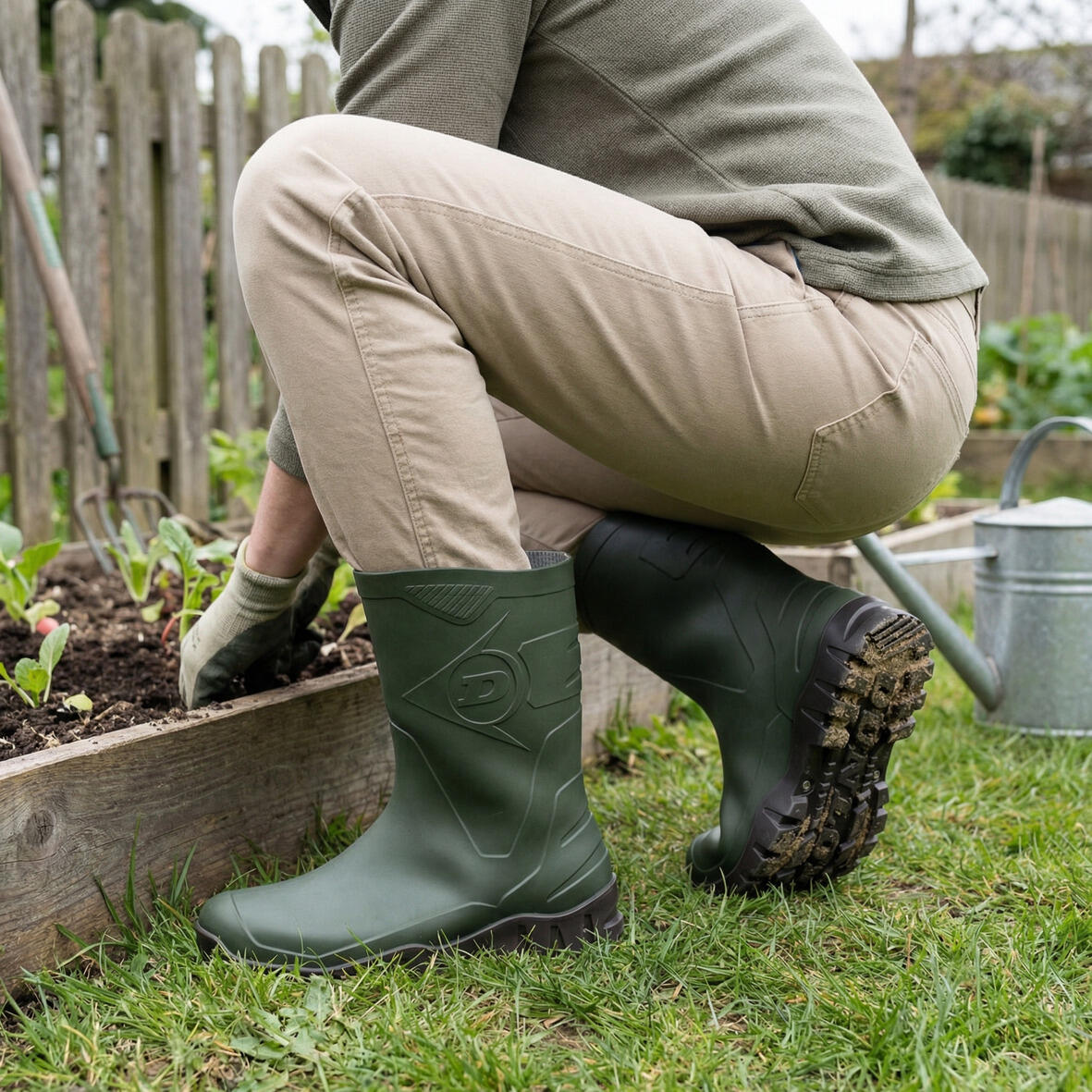
Hot weather changes your priorities.
In summer, breathability becomes almost as important as traction.
Look for:
- Breathable mesh
- Moisture-managing lining
- Lightweight construction
- Removable footbeds
- Ventilated materials
- Comfortable socks
Unless your grass is consistently wet, a heavy insulated waterproof boot probably isn’t your best summer choice.
Save that boot for winter.
Your feet will thank you.
Best Lawn-Mowing Shoes for Rain and Wet Grass
Rain changes the equation completely.
Wet grass can soak ordinary sneakers within minutes, while mud can destroy the traction of a smooth outsole.
For rainy conditions, consider:
- Waterproof hiking shoes
- Waterproof work boots
- Rubber ankle boots
- Wellington boots
- Waterproof landscaping boots
The XTRATUF Ankle Deck Boot is especially interesting if you want waterproof protection without a tall shaft.
For a broader selection of waterproof outdoor footwear, explore our farm and ranch work boot guide.
How to Keep Your Lawn-Mowing Shoes Clean
Don’t throw muddy footwear into the closet and pretend the problem doesn’t exist.
Future-you will not be impressed.
Step 1: Remove Grass Clippings
Brush or shake loose grass from the upper and outsole.
Step 2: Rinse Mud Away
For waterproof rubber or synthetic footwear, clean water is often enough for ordinary dirt.
Step 3: Let Them Dry
Allow the shoes to dry completely in a ventilated area.
Step 4: Clean the Footbed
If the insole is removable, take it out and allow it to air separately.
Step 5: Inspect the Outsole
Check for worn tread, cracks or embedded stones.
A lawn-mowing shoe doesn’t have to look showroom-fresh. It just needs to be clean enough, dry enough and structurally sound enough to do its job.
What Socks Should You Wear While Cutting Grass?
Good footwear deserves good socks.
For summer mowing, moisture-managing athletic or outdoor socks can help keep feet more comfortable.
For cooler weather, merino wool or other insulating outdoor socks can be useful.
Avoid cotton-only socks when your feet sweat heavily. Once cotton gets wet, it tends to stay wet.
And wet socks plus several hours of mowing?
That’s basically a recipe for blisters.
Common Lawn-Mowing Footwear Mistakes
Wearing Flip-Flops
This one should be obvious.
Open footwear leaves your feet exposed to debris and provides little protection around mower equipment.
Wearing Old Running Shoes
Running shoes can be comfortable, but many have tread and uppers designed for running rather than outdoor yard work.
Choosing Boots That Are Too Heavy
A giant industrial boot isn’t automatically the best lawn-mowing shoe.
If you’re mowing a small yard in summer, excessive weight can simply make the job more tiring.
Ignoring Wet Grass
If you regularly mow early in the morning, waterproofing deserves serious consideration.
Buying Without Considering Your Foot Shape
Width, arch shape, heel fit and toe-box space can make a huge difference.
Ignoring Mower Safety
Good footwear doesn’t replace proper mower operation.
Clear the mowing area, keep people and pets away, wear appropriate eye and hearing protection and follow the manufacturer’s instructions.
The University of Georgia’s landscaping safety checklist also emphasizes clearing debris and keeping people away from the mowing area.
Review the University of Georgia’s landscaping safety checklist.
Lawn-Mowing Shoes vs. Work Boots vs. Hiking Shoes
| Feature | Lawn Shoes | Work Boots | Hiking Shoes |
|---|---|---|---|
| Comfort | Excellent | Good to excellent | Excellent |
| Weight | Light | Medium to heavy | Light to medium |
| Waterproof options | Yes | Excellent selection | Excellent selection |
| Safety toe | Some models | Widely available | Rare |
| Wet grass traction | Good | Very good | Very good |
| Best for | Lawn and landscaping | Professional heavy-duty work | Comfortable outdoor chores |
Which Footwear Is Best for Professional Lawn Care?
Professional landscapers should generally think beyond “comfortable shoes.”
You may be mowing for several hours, climbing slopes, loading equipment, trimming edges and working around other machinery.
In that situation, a purpose-built landscaping shoe or safety work boot makes more sense than a basic sneaker.
The priorities should be:
- Traction
- Foot protection
- Comfort
- Water resistance
- Breathability
- Durability
- Appropriate safety certification
If your work includes construction or other demanding outdoor jobs, compare these options with our best work boots for welding and best oil- and slip-resistant work boots.
Best Shoes for Cutting Grass by Situation
| Situation | Best Choice |
|---|---|
| Small dry backyard | Lightweight lawn shoe |
| Wet morning mowing | Waterproof hiking shoe or ankle boot |
| Heavy rain | Waterproof rubber boot |
| Professional landscaping | Purpose-built landscaping shoe or safety boot |
| Rough terrain | Lugged hiking or work boot |
| Cold-weather mowing | Insulated waterproof work boot |
| Muddy property | Rubber Wellington or waterproof work boot |
Frequently Asked Questions
What are the best shoes for cutting grass?
For most homeowners, a lightweight lawn shoe such as the Kujo Yard Shoe offers an excellent balance of comfort, traction and outdoor protection. Professional landscapers may prefer a safety-rated landscaping shoe or work boot.
Can I wear sneakers to mow the lawn?
You can physically mow in sneakers, but ordinary sneakers provide less protection from debris and may have poorer traction on wet or uneven grass. Sturdy, closed-toe footwear is a safer choice.
Are steel-toe boots good for mowing?
They can be. Steel-toe boots provide additional toe protection and may be especially useful for professional lawn care and landscaping. However, they can be heavier than lawn shoes, so choose according to the job.
What are the best waterproof shoes for mowing grass?
Waterproof hiking shoes, waterproof work boots and rubber ankle boots are all good options. The XTRATUF Ankle Deck Boot is particularly interesting for wet grass because it combines waterproof construction with a slip-resistant outsole.
Are Wellington boots good for mowing?
Yes, particularly in wet or muddy conditions. They are waterproof and easy to clean. However, they may not provide as much cushioning or breathability as a dedicated landscaping shoe.
What should I wear to mow wet grass?
Choose waterproof footwear with good traction. A waterproof hiking shoe works well for moderate conditions, while rubber boots are better when the grass is extremely wet or muddy.
What shoes are best for mowing on hills?
Look for secure-fitting footwear with a traction-focused outsole and good lateral stability. Avoid smooth soles or loose-fitting boots.
Do I need waterproof shoes to cut grass?
Not always. If you mow during dry afternoons, breathable footwear may be more comfortable. If you mow early in the morning when dew is heavy, waterproofing can be very useful.
Are hiking shoes good for lawn mowing?
Yes. A waterproof hiking shoe can be an excellent choice for homeowners because hiking footwear is designed for uneven outdoor surfaces and usually provides good cushioning and traction.
What are the best shoes for professional lawn mowing?
Professional lawn care workers should look for durable landscaping shoes or work boots with strong traction, comfortable cushioning, weather resistance and the safety protection required by their workplace.
Can I wear sandals while mowing?
It’s strongly advisable to avoid sandals and other open footwear when operating powered lawn equipment. Closed-toe, sturdy footwear provides much better protection.
Final Ranking: Best Shoes for Cutting Grass in 2026
- Kujo Yard Shoes — Best overall lawn-mowing shoe.
- Timberland PRO Direct Attach — Best heavy-duty option.
- Merrell Moab 3 GORE-TEX — Best comfortable waterproof hiking shoe.
- XTRATUF Ankle Deck Boot — Best for wet grass.
- Kujo X1 Landscape Boot — Best for professional landscaping.
- Thorogood Wellington — Best pull-on work boot.
- Rocky-style waterproof work boot — Best for cold-weather mowing.
So, What Should You Buy?
If you’re a homeowner who wants something comfortable, light and specifically suited to yard work, Kujo Yard Shoes are an excellent starting point.
If you want something more like a traditional work boot, the Timberland PRO Direct Attach offers a much more rugged package.
If comfort is king and you want footwear you can use for mowing, gardening and hiking, the Merrell Moab 3 GORE-TEX is a smart option.
For wet lawns, muddy gardens and rainy days, XTRATUF Ankle Deck Boots are hard to ignore.
Professional landscapers should consider a purpose-built option such as the Kujo X1, particularly when safety and durability matter as much as comfort.
And if you simply love traditional pull-on boots, a good Wellington remains a remarkably practical choice.
The important thing is not to buy the biggest or toughest-looking boot just because it looks impressive.
Think about your actual mowing conditions.
Is the grass wet?
Is the yard sloped?
Are you mowing for 30 minutes or eight hours?
Do you need a safety toe?
Is it 100°F outside?
Once you answer those questions, the right footwear becomes much easier to find.
Because mowing the lawn should leave you with a beautifully trimmed yard — not two feet that feel like they’ve just completed a marathon.
More Work Boot & Outdoor Gear Guides
If your outdoor work goes beyond mowing, check our best Wellington work boots for pull-on options and our best oil- and slip-resistant work boots for greasy or wet work environments.
For workers who spend long hours standing, our plantar fasciitis work boot guide and flat-feet work boot guide can help narrow down comfort-focused choices.
If you’re doing more serious outdoor work, see our farm and ranch work boots and best Red Wing work boots.
For specialized trades, explore our best welding work boots and browse the steel toe work boot collection.
And because outdoor work requires more than footwear, check the work clothing section for additional jobsite gear.
Finally, if you’re heading out for an all-day construction or landscaping job, our guide to the best lunch coolers for construction workers can help keep your lunch in better shape than your lawn.
Safety note: Footwear is only one part of lawn-mowing safety. Follow the mower manufacturer’s instructions, clear debris from the mowing area, keep children and pets away, and use appropriate eye and hearing protection. For professional work, follow your employer’s PPE requirements and applicable safety standards.